Bhojanavagga
bhojanavagga #edited
introduction
4 + 1 kālika vibhāga (classification related to time) - purpose and period
- yāvakālika↔edibles consumed for the purpose of āhārakicca that can be accepted and consumed from dawn till the end of noon (yāva majjhaṇhikā) of the same day - Aruṇuggamanato yāva ṭhitamajjhanhikā bhuñjitabbato yāvakālikaṃ
- yāmakālika↔essences of certain yāvakālikas consumed for pipāsattha from dawn till the end of the last watch of the night - Aruṇuggamanato yāva yāmāvasānā pipāsāya sati pipāsacchedanatthaṃ pātabbato yāmo kālo assāti. (Khs.Mls. 111.)
- for bhesajjattha also seems ok
- sattāhakālika↔edibles that perform the āhārakicca but are not gross food, that are recognized conventionally as medicine and can be consumed for bhesajjattha for a period of seven days - "Tena upasametabbe ābādhe sati yāva sattāhā paribhuñjitabbato sattāhakālikaṃ." (Khs.Mls. 111.).
- notes:
- was originally food, became yāvajīvika, and then sattāhakālika
- oil extracted from yāvajīvika is also sattāhakālika
- yāvajīvika↔ edibles that do not perform āhārakicca, do not fall under other categories, and are consumed for bhesajjattha that can be kept for life (yāvajīvaṁ)‒Ābādhe sati yāvajīvaṃ pariharitvā bhuñjitabbato yāvajīvikaṃ.
- akālika↔water - it does not fall under any of the above categories; can be consumed as long as it exists
- notes:
- yāvakālika, yāvajīvika and akālika are the first three main categories
- 5 yāma (watches)
- from dawn to noon
- from noon to sunset
- 3 watches of the night
- from 6 pm to 10 pm
- from 10 pm to 2 am
- from 2 am to 6 am
ajjhoharaṇīya↔edible / consumable items - that can be consumed internally #\[\[pāḷi vocab (2nd year)]]
time periods
- kāla / purebhatta - from dawn to the end of noon (noon included) - 2 parts
- pubbaṇha – from dawn till the beginning of the ṭhitamajjhaṇha
- ṭithamajjhaṇha / majjhaṇha – the noon; the period in which the sun is at the peak of its path in the sky
- note: in dhammasanganī a mahathera is said to have eaten a whole meal at this time, giving the impression that it is a (short) period of time, not a brief moment
- extra notes:
- purebhatta has various meanings according to the context it is used but in general, purebhatta is the time before pacchābhatta - 4 types of pacchābhatta
- from the end of the meal till the end of noon (purebhattaṃ vā pacchābhattaṃ vā kulesu cārittaṃ āpajjeyya)
- from the end of the meal till the dawn of the following day (pacchābhattaṃ piṇḍapātapaṭikkanto)
- vikāla (Ettha madhukapuppharaso aggipāko vā hotu ādiccapāko vā, pacchābhattaṃ na vaṭṭati)
- after the end of noon till the sunset (Pacchābhattaṃ nāma majjhanhike vītivatte yāva atthaṅgate sūriye).
- vikāla (/pacchābhatta / aparaṇha) – from the end of the noon till the break of the next dawn
- suriyuggamana↔sunrise
- aruṇuggamana↔the break of dawn
- suriyatthaṅgamana↔sunset
- notes:
- how time was calculated: using columns (kālatambha) and other signs
- “Jambudīpassa kālena paricchedoti evaṃ kira”. (4Kṅk-pu-ṭ. 93.) some say that kāla applies to the time according to Jambudīpa, which implies that consuming food in Uttarakurudīpa during kāla in Jambudīpa is deemed acceptable, even though it is believed to be vikāla there
- yāma‒from one break of dawn to the next
2 paribhuñjana (types of consumption)
- āhāratthāya paribhuñjana (consumption for nourishment, for removing hunger)
- āhārattha / āmisattha / āhārakicca↔benefits / function of food
- jigacchāharaṇa↔to quench the hunger
- from ghasati, gaghasati, jigaccha
- jigacchāharaṇatthāya↔for the benefit of quenching hunger
- which edibles can be consumed for āhārakicca during the kāla of the same day they were accepted?
- all of them (yāva-, yāma-, sattāha-kālikas and yāvajīvika)
- which of them can be consumed for āhārakicca during the vikāla or on another day after the day on which they were accepted?
- sati paccaye paribhuñjana (consumption when in a need other than nourishment) - 2 types
- pipāsattha↔to quench the thirst
- bhesajjattha↔for medicinal purpose
at what period of time and for which purpose can each edible be consumed?
- yāvakālika
- time: during kāla of the day it was received
- purpose: any purpose
- yāmakālika
- time: the same day it was received
- purpose:
- āhārattha - only during kāla
- pipāsattha - during kāla or vikāla
- bhesajjattha? it seems like it can be taken for bhesajjattha, but it is normally said to be for pipāsattha #q🙋🏼♂
- sattāhakālika
- time: up to 7 days
- purpose:
- āhārattha - only during kāla of the day it was received
- bhesajjattha - at any time up to 7 days
- pipāsattha? #q🙋🏼♂
- yāvajīvika
- time: at any time for life
- purpose:
- āhārattha - only during kāla of the day it was received
- bhesajjattha - at any time
- pipāsattha? #q🙋🏼♂
- akālika: at any time, for any purpose
- srtdpn: udakañhi yathāsukhaṃ pātuṃ vaṭṭati
- vmtvndn: water is technically a bhesajja, but not as yāvajīvika bhesajja
it doesn't count as accepted even if done so
doing paccavekkhaṇa on it is encouraged, but not needed;
other medicines must be taken after having done paccavekkhaṇa, otherwise it is a dkṭ
3 mukhadvāra
- mukha mukhadvāra (entrance of the mouth - lips): refered to in the sekhiya "na anāhaṭe kabale mukhadvāraṁ vivarissāmīti sikkhākaraṇīyā"
- galanāḷika / paragala / kaṇṭhanāḷi mukhadvāra (entrance to the esophagus; pharynx): “mukhe dvāraṃ mukhadvāraṃ" - in which only paṭiggahita edibles can go through
- nāsikadvāra↔nostrils - medicines that go through the nasopharynx cavities into the esophagus must be paṭiggahita
- note: #\[\[pāḷi vocab (2nd year)]]
- ajjhohāra "ajjhohāre ajjhohāre pācittiyaṁ"↔the act of swallowing
- paṭiggahita↔accepted items
kālika
- how to determine whether an edible is yāvakālika or yāvajīvika?
- (vnysgh-a) "...yaṃ kiñci mūlaṃ tesu tesu janapadesu pakatiāhāravasena manussānaṃ khādanīyatthaṃ bhojanīyatthañca pharati, taṃ yāvakālikaṃ, itaraṃ yāvajīvikanti veditabbaṁ."
if it performs the conventional āhārakicca for humans in a particular region, it should be considered a yāvakālika in that region - if not, yāvajīvika
- pharati \[√phar + a + ti] 2↔pr. (+acc) serves (as); is useful (as)
- vnylkr: some edibles may be yāvakālika in one region and yāvajīvika in another - that is due to the differences in the types of nutrients in the soil (bhūmirasa/paṭhavirasa)
- srtdpn: because in one region it may serve as food, while in others, is may not suit as food
- note: some teachers are of the opinion that if a certain food perform āhārakicca for humans in a certain region, it must be taken as yāvakālika in all other regions
- "neva pharanti na nipphādenti. Ekasmiṃ dese āhārakiccaṃ sādhentaṃ vā asādhentaṃ vā aparasmiṃ dese uṭṭhitabhūmirasādibhedena āhārajighacchāharaṇakiccaṃ asādhentampi vā sambhaveyyāti āha "tesu tesu janapadesū"tiādi." (Vlṅk-ṭ. I. 187.).
- Tesu tesu janapadesūti ettha ekasmiṃ janapade āhārakiccaṃ sādhentaṃ sesajanapadesupi na kappatī"ti vadanti. (Srd-ṭ. III. 65.).
- vocab: #\[\[pāḷi vocab (2nd year)]]
- bhūmirasa / paṭhavirasa↔nutrients of the soil
- kappati \[√kapp + a + ti]↔pr. (+dat) it is suitable (for); it is proper (for); it is fitting (for); it is allowable
- sādhenta \[√sādh + \*e + nta]↔prp. (+acc) successfully accomplishing; concluding; proving 2 prp. accomplishing, preparing
- 5 aspects to be known
- paṭiggahaṇa↔the acceptance of edibles
- saṃyojana↔the mixing of edibles
- attha↔the purpose of consuming edibles
- ajjhoharaṇa↔the consumption of edibles
- pariccajana↔the relinquishment of edibles
- 5 edibles (kālika and akālika)
- yāvakālika
- what is their main characteristic?
- they are conventionally consumed for āhāratthāya for certain benefits of food
- Khādanīyatthaṃ bhojanīyatthañca pharaṇābhāvoyeva pana tesaṃ lakkhaṇaṃ. Tasmā yaṃkiñci mūlaṃ tesu tesu janapadesu pakatiāhāravasena manussānaṃ khādanīyatthaṃ bhojanīyatthañca pharati, taṃ yāvakālikaṃ, itaraṃ yāvajīvikanti veditabbaṃ. Tesu bahuṃ vatvāpi hi imasmiṃyeva lakkhaṇe ṭhātabbaṃ. Nāmasaññāsu pana vuccamānāsu taṃ taṃ nāmaṃ ajānantānaṃ sammohoyeva hoti, tasmā nāmasaññāya ādaraṃ akatvā lakkhaṇameva dassitaṃ. (V-a. III. 99.).
- is it an offense to consume it for rasatthāya (for the taste), for davatthāya (for fun) or to satisfy the desires of the donors?
- there is no offence, but it is not recommended
- notes: puttamaṁsopanasutta
- what happens if it is kept after midday? and if then consumed? what if it is kept overnight? and if then consumed?
- if kept after midday, nothing happens, but if consumed during the vikāla, it entails a pct
if kept overnight, it becomes sannidhi, which is not an offense, but if consumed, it entails a pct
- sannidhi↔stored (food)
- 2 types of yāvakālika
- khādanīya: all yāvakālikas other than pañca bhojana - Khādanīyaṃ nāma pañca bhojanāni yāmakālikaṃ sattāhakālikaṃ yāvajīvikaṃ ṭhapetvā avasesaṃ khādanīyaṃ nāma.
- examples:
- (1). Yāgu – porridge cooked with pubbaṇṇa and aparaṇṇa grains
- (2). Aparaṇṇa grains
- (3). Sakkhali and modaka made out of pubbaṇṇa and which does not fall into modaka sattu.
- (4). Modaka and sakkhali made out of aparaṇṇa
- (5). Mūla khādanīya – roots of trees and creepers
- (6). Kandha khādanīya – tubers or yam
- (7). Muḷāla khādanīya – edible root of the lotus plant (but it is mentioned in the commentary that there are muḷala in other trees as well – nāḷikera muḷāla, pūgarukkha muḷāla).
- (8). Matthaka. (kaḷīra) khādanīya – sprout of trees such as coconut, palm bamboo, sugarcane and so on
- (9). Khandha khādanīya – stalks such as sugarcane
- (10). Taca (challi) khādanīya – bark of a tree
- (11). Patta khādanīya – leaves
- (12). Puppha khādanīya – flowers
- (13). Phala khādanīya – fruits
- (14). Aṭṭhi khādanīya – seeds
- (15). Piṭṭhi khādanīya – flour made out of grains
- etc
- 5 bhojanīya / bhojana
- odana: boiled sattadhaññā (pubbaṇṇa) or dhaññānuloma
- the book says "rice cooked with dhaññānuloma"‒could it just be boiled dhaññānuloma? #q🙋🏼♂
- sattadhaññā
- sāli (hill rice)
- vīhi (rice)
- yavo (barley - Hordeum vulgare)
- godhumo (wheat)
- kaṅgu (millet - Panicum indicum)
- varako (wild gram / bean - Phaseolus trilobus)
- kudrusako (kodo millet / finger millet - Eleusine coracana / ragi seed?)
- mem aid:
- Pāḷi: salve a vo gorda na canga com uma vara no cu
- English: two rices were at the bar drinking beer eating millet and wild beans with their fingers
- dhaññānuloma
- nīvāra, varaka, and coraka - they are not explained
- mem aid: hindrances and excellent thieves
- bhatta↔ cooked grains (odana)
- yāgu↔porridge (not odana)
- pāyāsa↔ rice cooked with milk, of which there are different kinds such as khīra- (milk) or ambila-(sour milk) pāyāsa
- bhojjayāgu↔a dish that should be first eaten and then drunk (bhuñjitvā pātabbayāgu)
- what is its main characteristic?
- after one scoops out a spoonful, the mark of the spoon remains, leaving a gap - regardless of what type of dish it is (but it must have at least a handful of grains)
- what if such spoon marks cannot be seen?
- the dish is then yāgu, not odana - but after cooling down, if they turn thick and marks of spoons appear after scooping, it then becomes odana
- how much grains must be present in a dish of other foods for it to be odana?
- it must contain at least a handful of pubbaṇṇa grains and marks of spoonfuls remain after scooping
- is baked, steamed, or fried dhañña bhojana?
- jnkbvs: baking, steaming or frying do not make them bhojana
- kummāsa: half-boiled sattadañña
- notes:
- “Addhasinnā ca godhumā – aññeca caṇkādayo; kummāsa-iti katyante - …” (Thomanidhi Sanskrit Dictionary): kummāsa is not something made out of half-boiled rice, but half-boiled rice itself
Jnkbvs: this definition supports raṭṭhapālasuttavaṇṇanā in which raṭṭhapālatthero is offered kummāsa
- general definition: “Kummāso nāma yavehi katakummāso". (V-a. III. 90.) something made with yava grains
Pācittiyādiyojanā: yavehi (plural) shows that all sattadhaññas can be used - “Yavehīti bahuvacanena satta dhaññānipi gahitāni”. (Pc.ay. 71.).
- sattu: "flour" 3 types
- kuṇḍakasattu – broken pubbaṇṇa grains which were heavily roasted
- if slightly roasted or merely heated under the sun, they are not bhojana
- Sattu nāma satta dhaññāni bhajjitvā kato. Antamaso kharapākabhajjitānaṃ vīhīnaṃ taṇḍule katacuṇṇampi kuṇḍakampi sattusaṅgahameva gacchati. Samapākabhajjitānaṃ pana ātapasukkhānaṃ kuṇḍakaṃ vā, ye keci taṇḍulā vā lājā vā, lājehi katabhattasattuādīni vā na pavārenti. (Kṅk. 220-1.).
- cuṇṇa- / piṭṭha-sattu: powder / flour sattu - 3 types
- pubbaṇṇa grains
- "kharapākabhajjita-thusapalāpita-koṭṭita-sattadhañña"‒heavily roasted, then husked
- (or infertile grains) "samapākabhājjita-thusapalāpita-koṭṭita-sattadhañña vā sattadhaññapalāpa (?) vā"‒ slightly roasted, then husked
- "thusapalāpita-bhajjita-koṭṭita-sattadhañña"‒husked, then roasted
- all are finally pounded into flour
- note:
- the Pāḷi names are my attempt to name them according to their nature
- only after pounding do they become bhojana
- mem aid: heavily roasted, slightly roasted, husked and roasted
- modaka- / guḷa- / pūva-sattu: dishes made of cuṇṇasattu without recooking it
- what if sattu is recooked?
- if recooked ⇒ not bhojana
"Sattumodakoti sattuṃ temetvā kato apakko. Sattuṃ pana pisitvā piṭṭhaṃ katvā temetvā pūvaṃ katvā pacanti, taṃ na pavāreti." (Vmv-ṭ. II. 29.)
Sattumodakoti sattuyo piṇḍetvā kato apakko sattuguḷo. Vimativinodaniyaṃ pana "sattumodakoti sattuṃ temetvā kato apakko, sattuṃ pana pisitvā piṭṭhaṃ katvā temetvā pūvaṃ katvā pacanti, taṃ na pavāretī"ti vuttaṃ. (Vlṅk-ṭ. I. 222-2.)
e.g: fried rice, baked rice, steamed rice, bread, pasta...are not odana, kummāsa, nor sattu, but khādanīya
- what about recooked dhañña?
- if recooked, they are still bhojana - only recooked sattu is not
- notes:
- taṇḍula↔husked dhañña
- can dhañña and taṇḍula be accepted?
- dhañña cannot be accepted, but taṇḍula can
- bhojana or not?
- heavily roasted: bhojana
slightly roasted:
pounded ⇒ bhojana
not pounded ⇒ not bhojana
- kharapākabhajjita↔heavily roasted #\[\[pāḷi vocab (2nd year)]]
- samapākabhajjita↔slightly roasted #\[\[pāḷi vocab (2nd year)]]
- khara "kharapākabhajjitānaṁ"↔adj. rough; hard; harsh; painful; 2 adj. hard, solid #\[\[pāḷi vocab (2nd year)]]
- bhajjita "kharapākabhajjitānaṁ"↔pp. roasted, toasted #\[\[pāḷi vocab (2nd year)]]
- maccha: flesh of any aquatic beings that would die if put onto the ground
- maṃsa: flesh of terrestrial animals
- 10 akappiyamaṁsasatta - unallowable sources of hair, skin, meat, blood, or bones #\[\[vibhaṅga exam]]
- tlc offense
- dkṭ offenses
- hatthi
- assa
- sunakha
- ahi
- sīha
- vyaggha
- dīpi
- accha
- taraccha (hyena)
- mem aid: human on an elephant, big to small (elephant, horse, dog, snake), 3 cats in order of power (lion, tiger, leopard), accha, taraccha
- what animal products are allowed?
- ghee (sappi)
- fresh butter (navanīta)
- animal fat (vasātelaṁ - except human)
- milk (khīraṁ)
- curd (dadhi)
- butter milk (takka)
- note: of all living beings (including human)
- notes:
- Na hi akappiyamaṃsasattānaṃ sappiādīni na kappanti. Ekañhi manussavasātelaṃ ṭhapetvā sabbesaṃ khīrasappinavanītavasātelesu akappiyaṃ nāma natthi. (Srd-ṭ. III. 68.)
- vasātela nt.↔tallow; suet oil; animal fat; lit. grease oil #\[\[pāḷi vocab (2nd year)]]
- what type of edibles are these products?
- vasātela, sappi, and navanīta are sattāhakālika
khīra, dadhi and takka are yāvakālika
- 3 types of unallowed meat / blood is not allowed ? #\[\[vibhaṅga exam]]
- not raw (āmaka)
- unless possessed by a non-human – “Anujānāmi, bhikkhave, amanussābādhe āmakamaṃsaṃ āmakalohitaṃ”.
- not from akappiyamaṁsasatta
- not uddissakataṁ / paṭiccakamma maṁsaṁ
- the monk must not have seen, heard or suspected that it is so
- notes:
- uddissakataṁ / paṭiccakammaṃ maṃsaṃ↔meat of an animal that was slaughtered for the sake of offering its meat to any of the sahadhammikas
- pavattamaṃsa↔meat of an animal that died naturally or not slaughtered for the sake of offering its meat to any of the sahadhammikas
- āmakamaṃsa↔uncooked meat
- āmaka \[āma + ka] adj.↔raw; uncooked 2 adj. unripe; green 3 adj. (of clay) raw; damp; unbaked; not fired
- note:
- yāgu with fish or meat ⇒ (bhojana or not?) bhojana
yāgu with meat gravy / fish gravy, or the gravy by itself ⇒ (bhojana or not?) not bhojana #q🙋🏼♂
- gravy↔1. The juice or other liquid matter that drips from flesh in cooking, made into a dressing for the food when served up. 2. Liquid dressing for meat, fish, vegetables, etc.
- Sace pana pakkuthitesu udakādīsu pakkhipitvā pacitvā denti, yāgusaṅgahameva gacchati. Yāgusaṅgahaṃ gatepi tasmiṃ vā aññasmiṃ vā yattha macchamaṃsaṃ pakkhipanti, sace sāsapamattampi macchamaṃsakhaṇḍaṃ vā nhāru vā paññāyati, pavāraṇaṃ janeti. Suddharasako pana rasakayāgu vā na janeti. (V-a. III. 90.).
- yāmakālika
- what happens if kept overnight?
- it becomes sannidhi, if consumed it entails a pc
- aṭṭhapāna (8 juices)
- ambapāna (mango)
- jambupāna (rose apple)
- cocapāna (banana with seeds)
- mocapāna (banana without seeds)
- madhupāna (mahua)
- muddikapāna (grapes)
- sālukapāna (water-lily roots)
- phārusakapāna (sweet berry)
- khuddakaphala↔fruits included in the aṭṭhapāna and those in conformity with them, e.g: lime, oranges, tamarind...
- yāva or yāmakālika?
fruit itself ⇒ yāvakālika
fruit extract ⇒ yāvakālika
extract + ambient / cold water ⇒ yāmakālika
essence obtained by sunning (exposing to sun in water) ⇒ yāmakālika
extract extracted by boiling with fire ⇒ yāvakālika
extract extracted by boiling with fire + ambient / cold water ⇒ yāmakālika according to bhāsaṭīka
- 3 types of yāmakālika
- phalarasa (fruit juices): all juices of khuddakaphalas with ambient / cold water or extracted by sunning, except dhaññarasa
“Anujānāmi, bhikkhave, sabbaṃ phalarasaṃ ṭhapetvā dhaññarasaṃ”
- yāva or yāma kālika?
- sānulomadhaññarasa
dhaññarasa with ambient / cold water ⇒ yāvakālika
dhaññarasa extracted by sunning ⇒ yāvakālika
dhaññarasa extracted by boiling ⇒ yāvakālika
washing water of dhañña ⇒ yāvakālika
mahāphalarasa ⇒ yāvakālika
- khuddakaphalarasa ⇒ yāmakālika
yāvakālika juice mixed with water ⇒ yāmakālika according to bhāsaṭīka
- what is sānulomadhaññarasa? #q🙋🏼♂
- notes:
- extracting the juice and mixing it with hot water is not mentioned - it seems to be ok
- guḷa (sattāhakālika) + water ⇒ yāvajīvika
anujānāmi bhikkhave gilānassa guḷaṁ agilānassa guḷodakaṁ
I allow, monks, guḷa for the sick and guḷodaka for the non-sick
- 9 mahaphala (dhaññānuloma) #\[\[vibhaṅga exam]] #\[\[tricky vibhaṅga]]
- tāla (palm fruit / palmyrah)
- nāḷikera (coconut)
- panasa (jackfruit)
- labuja (breadfruit)
- alābu (bottle gourd / calabash)
- kumbhaṇḍa: “Kumbhaṇḍanti mahāphalo sūpasampādako latāviseso” – a fruit that grows in creepers that is used to make sūpa”
SL: watermelon
Myanmar: type of gourd / pumpkin
- tipusa (small kekiri / ash pumpkin): "Kakkārikanti khuddaka-eḷālukaṃ, tipusanti ca vadanti”
- eḷāluka (kekiri / type of cucumber - Cucumis utilissimus / melon)
- phussa (cucumber)
- mem aid: the palm and the coconut doing 50 jumping jacks eating bread with their two gourd-like balls, heavy as lead, and their cucumber, touching the floor
- pattarasa (leaf juices): all juices of yāvakālika leaves with ambient / cold water or extracted by sunning, except ḍākarasa
“Anujānāmi, bhikkhave, sabbaṃ pattarasaṃ ṭhapetvā ḍākarasaṃ” -
- applicable only for yāvakālika pattas, not yāvajīvikapatta
- which ones are they specifically? #q🙋🏼♂
- so, for example, filtered spinach juice?
- ḍākarasa↔drink of boiled (on the fire) yāvakālika leaves - yāvakālika #\[\[pāḷi vocab (2nd year)]]
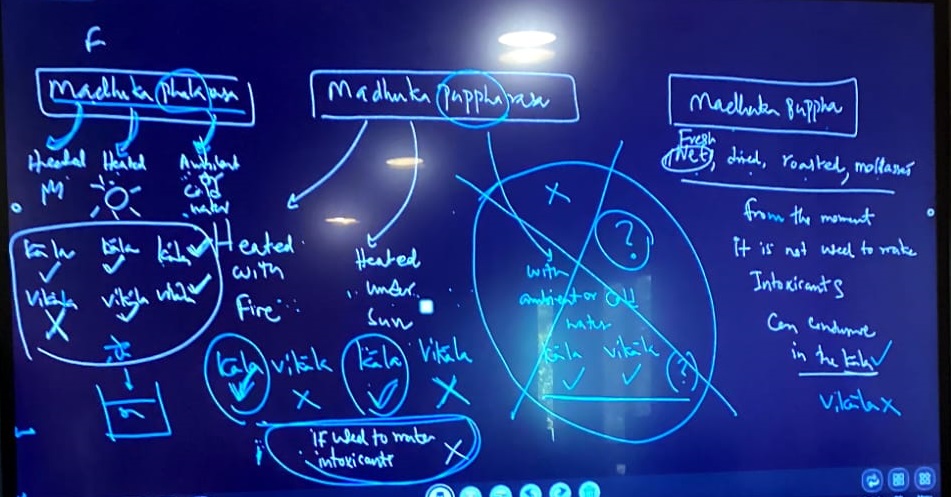
- puppharasa (flower juices): all juices of yāvakālika flowers with ambient / cold water or extracted by sunning, except madhukapuppharasa
“Anujānāmi, bhikkhave, sabbaṃ phupparasaṃ ṭhapetvā madhukapuppharasaṃ”
- madhukapuppharasa↔the essence made of these Mahua flowers - sometimes used for making intoxicants
- allowed or not, and when?
extracted by boiling the flower with fire ⇒ yāvakālika
extracted by sunning ⇒ yāvakālika!
(extract with ambient / cold water is not discussed but seems yāmakālika)
madhukapuppharasa used for making intoxicants ⇒ from the moment it is used for making intoxicants, it is not allowed at all
fresh / dry / roasted madhukapuppha and its phāṇita (molasses) ⇒ before the pāna is used for making intoxicants, it is allowed during kāla, after, not allowed!
summary: always yāvakālika, and not allowed when used for intoxicants
note: madhukaphalarasa is like other allowable juices #tbc🕵
- "ṭhapetvā madhukapuppharasanti ettha madhukapuppharaso aggipāko vā hotu ādiccapāko vā, pacchābhattaṃ na vaṭṭati. Purebhattampi yaṃ pānaṃ gahetvā majjaṃ karonti, so ādito paṭṭhāya na vaṭṭati. Madhukapupphaṃ pana allaṃ vā sukkhaṃ vā bhajjitaṃ vā tena kataphāṇitaṃ vā yato paṭṭhāya majjaṃ na karonti, taṃ sabbaṃ purebhattaṃ vaṭṭati." (V-a. III. 383-4.).
- madhuka \[madhu + ka] masc.↔Butter tree; Mahua; Bassia latifolia
- notes:
- if extracted by boiling, they are yāvakālika
- ekāsanikaṅga monk cannot take yāmakālika during kāla for āhāratthāya
- sattāhakālika
- 5 types #\[\[vibhaṅga exam]]
- sappi (ghee)
- navanīta (butter)
- tela (oils)
- madhu (honey)
- phāṇita (products of sugar cane without bagasse: jaggery, juice \& resin)
- jaggery
note: jaggery can be made either by boiling or without boiling the pure sugar cane juice
- ucchukasaṭa↔sugar cane bagasse - yāvakālika #\[\[pāḷi vocab (2nd year)]]
- bagasse↔the dry dusty pulp that remains after juice is extracted from sugar cane or similar plants
- yāva / yāma / sattāha kālika? - 4 cases #\[\[vibhaṅga exam]]
- unstrained sugar cane juice, received by an anupa, who then, cooks it into jaggery ⇒ yāvakālika
unstrained, upasampanna during kāla, strains it and cooks it into jaggery ⇒
no sāmaṁpāka - since the kasaṭa was removed before the cooking
can only be consumed during kāla (srtdpn)
note: like a sattāhakālika that can only be consumed during kāla (bhante's opinion)
(extra note: vmtvndn suggests the kasaṭa becomes yāvajīvika while cooking\*)
consuming it during the vikāla ⇒ seems to be a dkṭ, not a pc
if cooked without having strained it ⇒ sāmaṁpāka dkṭ
it is not yāvakālika because ⇒ the kasaṭa was removed
can it be mixed with yāvakālika during kāla? ⇒ no, because it was cooked by an upa
strained, anupa, cooks it into jaggery ⇒ sattāhakālika (during kāla of the day it is accepted it can be mixed with food)
strained, upa, cooks it into jaggery ⇒ sattāhakālika (during kāla of the day it is accepted, it cannot be mixed with food because it was cooked by an upa - but it can be consumed by itself for āhārattha during kāla, and bhesajjattha for 7 days)
- \*Nirāmisameva vaṭṭati tattha paviṭṭhayāvakālikassa abbohārikattāti idaṃ guḷe kate tattha vijjamānampi kasaṭaṃ pākena sukkhatāya yāvajīvikattaṃ bhajatīti vuttaṃ. Tassa yāvakālikatte hi sāmaṃpākena purebhattepi anajjhoharaṇīyaṃ siyāti. (Vmv-ṭ. I. 353.).
- jhāma ucchuphāṇita↔made with sugar cane from a field that was burnt - sattāhakālika
- jhāma \[√jhe + a + ma]↔adj. burnt; scorched; charred #\[\[pāḷi vocab (2nd year)]]
- koṭṭhita ucchuphāṇita↔made with sugar cane that was cut into small pieces, crushed and cooked and that contains tiny kasaṭa - sattāhakālika because such tiny kasaṭa is abbohārika
- abbohārika \[na \> a + vi + ava + √har + \*a + ika]↔adj. negligible; insignificant; lit. not prosecutable
- "Jhāmaucchuphāṇitaṃ vā koṭṭitaucchuphāṇitaṃ vā purebhattameva vaṭṭatī"ti mahāaṭṭhakathāyaṃ vuttaṃ. mahāpaccariyaṃ pana "etaṃ savatthukapakkaṃ vaṭṭati, no vaṭṭatī"ti pucchaṃ katvā "ucchuphāṇitaṃ pacchābhattaṃ novaṭṭanakaṃ nāma natthī"ti vuttaṃ, taṃ yuttaṃ. (V-a. III. 294.). Jhāmaucchuphāṇitanti agginā daḍḍhe ucchukhette jhāmaucchunā kataphāṇitaṃ. Koṭṭitaucchuphāṇitanti khuddānukhuddakaṃ chinditvā koṭṭetvā nippīḷetvā pakkaṃ yebhuyyena ca sakasaṭaṃ phāṇitaṃ. Tādisassa ca kasaṭassa abbohārikattā "taṃ yutta"nti vuttaṃ. (Srd-ṭ. II. 433.).
- nikkasaṭa ucchurasa↔sugarcane juice without bagasse - sattāhakālika #\[\[pāḷi vocab (2nd year)]]
- why this juice is considered as sattāhakālika?
- “Phāṇitaṃ nāma ucchumhā nibbattaṃ” (pācittiyapāḷi) – “Phāṇita is the items produced from sugarcane”
comm: “Sabbāpi avatthukā ucchuvikati phāṇitanti veditabbā” (V-a. III. 294.) All types of products from sugarcane without sugarcane pieces or bagasse must be known as phāṇita
sub-comm: “Ucchurasopi nikkasaṭo sattāhakālikoti veditabbo” - sugarcane juice without bagasse is also sattāhakālika
- ucchuniyyāsa / ucchujatu↔gum / resin of sugarcane - sattāhakālika - “Niyyāsakhādanīye eko ucchuniyyāsova sattāhakāliko”
- niyyāsa masc \[nī + √yas + \*a]↔gum; resin; milk; fluid extract #\[\[pāḷi vocab (2nd year)]]
- jatu nt.↔lac; gum; resin #\[\[pāḷi vocab (2nd year)]]
- Imāni kho pañca bhesajjāni, seyyathidaṃ – sappi, navanītaṃ, telaṃ, madhu, phāṇitaṃ, bhesajjāni ceva bhesajjasammatāni ca lokassa, āhāratthañca pharanti, na ca oḷāriko āhāro paññāyati.
- it was first allowed to accept and consume them during kāla
then it was extended for 7 days and they were allowed to be consumed during kāla and vikāla
- if accepted on Sunday, when does it expire and what happens then?
- it expires on the dawn of the next Sunday and becomes nissaggiya - the monk entails a pc - if consumed afterwards, it is a dkṭ
- (1 - accepted) Sun | (2) Mon | (3) Tue | (4) Wed | (5) Thu | (6) Fri | (7) Sat | (8 - dawn) Sun
- note:
on day 1, it can be mixed with food during kāla and consumed for āhārattha
on day 1, it can also be mixed with yāmakālikas accepted on the same day and consumed during the vikāla for bhesajjattha
at any time it can be consumed for bhesajjattha until it expires
- yāvajīvika
- what is its main characteristic?
- not performing the āhārakicca
- can yāvajīvika be cooked by monks?
- is paccavekkhaṇa compulsory?
- before consuming bhesajja, paccavekkhaṇa is compulsory
consuming it without paccavekkhaṇa, or consuming it without a reason, is a dkṭ
- various types of yāvajīvika items (no memorization)
- mūla bhesajja – roots of trees and creepers
- muḷāla bhesajja
- muḷāla nt.↔edible root of the lotus plant
- kanda bhesajja – tubers or yam
- matthaka bhesajja – sprouts
- khandha bhesajja – stalks
- taca / kāsāva bhesajja – bark
- niyyāsa / jatu bhesajja – gum / resin
- paṇṇa / patta bhesajja – leaves
- puppha bhesajja – flowers
- phala bhesajja – fruits
- aṭṭhi bhesajja – seeds
- piṭṭha bhesajja – flour, powder
- mem aid: from bottom to top of a plant
- akālika
- should water be offered?
- “Udake hi paṭiggahaṇaṃ na ruhati”
"Bhikkhu pidahitvā udakaṃ tāpeti, yāva parikkhayā paribhuñjituṃ vaṭṭati. Sace panettha chārikā patati, paṭiggahetabbaṃ" (V-a. III. 118.).
no, even if offered, water does not count as an offered item
in case ashes / dust fall in it, it should be offered
- can it be mixed with other edibles?
- it can be mixed with anything at any time - in some cases, changing the nature of the edible
e.g: if mixed with fruit extracts which are yāvakālika, it makes the resultant essence a yāmakālika
- can seawater be used without it being offered?
- yes, if there is no salt in the food, seawater can be added by the monk himself
- Loṇe asati samuddodakena loṇakiccaṃ kātuṃ vaṭṭati. (V-a. III. 119.).
Samuddodakenāti appaṭiggahitasamuddodakena. (Srd-ṭ. III. 75.).
- water is considered as medicine - how can it be consumed? should paccavekkhaṇa be done?
- it is considered as a medicine, but not like yāvajīvika medicine, and can be consumed as one likes without any reasons and without doing paccavekkhaṇa
- Āhāranti ajjhoharitabbaṃ kālikaṃ adhippetaṃ, na udakaṃ. Tañhi bhesajjasaṅgahitampi akālikameva paṭiggahitasseva kālikattā. Udake hi paṭiggahaṇaṃ na ruhati. Teneva bhikkhunā tāpitena udakena cirapaṭiggahitena ca akappiyakuṭiyaṃ vutthena ca saha āmisaṃ bhuñjantassāpi sāmapākādidoso na hoti. Vakkhati hi "bhikkhu yāguatthāya…pe… udakaṃ tāpeti, vaṭṭatī"tiādi. Bhikkhū pana etaṃ adhippāyaṃ tadā na jāniṃsu. (Vmv-ṭ. II. 35.).
āvasathapiṇḍasikkhāpadaṃ
background
- Buddha in Jtvn; a hourseholder established a dānasālā; chabbaggiya, not finding alms, went there and ate; on the 2nd day, they went there again; 3rd day, the same happened and they decided to stay there overnight and keep eating there; other renunciants left the place; people criticized; Buddha prohibited;
V. Srpt ate in a dānasālā, fell ill and had to stay there overnight; next day, though offered food, he did not accept it; Buddha allowed when ill
description
- āvasathapiṇḍa
- bhojana: one of the five bhojanas
- anodissa: that is prepared and set for any individual
- yāvadatthaṃ bhuñjituṃ: to eat as much as they please
- the location is irrelevant for the rule, but it could be set in an āvasatha (rest house / traveller's lodge), hall (sālā), stage (maṇḍapa), under a tree (rukkhamūla) or an empty space (ajjhokāsa)
- note:
- āvasathapiṇḍoti āvasathe piṇḍo. samantā parikkhittaṃ addhikagilānagabbhinipabbajitānaṃ yathānurūpaṃ paññattamañcapīṭhaṃ anekagabbhapamukhaparicchedaṃ āvasathaṃ katvā tattha puññakāmatāya piṇḍo paññatto hoti, yāgubhattabhesajjādi sabbaṃ tesaṃ tesaṃ dānatthāya ṭhapitaṃ hotīti attho.
- āvasatho piṇḍoti puññatthikehi ekaṃ pāsaṇḍaṃ anuddissa yāvadatthaṃ dātuṃ sālādīsu paññattaṃ pañcasu bhojanesu aññataraṃ bhojanaṃ. yathāha "āvasathapiṇḍo nāma pañcannaṃ bhojanānaṃ aññataraṃ bhojanaṃ sālāya vā maṇḍape vā rukkhamūle vā ajjhokāse vā anodissa yāvadattho paññatto hotī"ti (pāci. 206).
- how many times can it be consumed by agilāna upa?
- accepting āvasathapiṇḍa intending to consume it, after having eaten once: dkṭ
consuming it: pc for every swallow
- how many times can it be consumed:
from several dānasālās set up by a single family? only once in total
consuming more: receiving dkṭ, swallowing pc
consuming one day from one sāla, and the next day from another sālā: āpatti
from several dānasālās set up by multiple families (separately)? maximum one meal a day and only one from each dānasālā (kkvtrṇ-ṭ)
eating twice the same day from different dānasālās set up by different families: āpatti (kkvtrṇ-ṭ)
after having eaten once from each dānasālās set up by multiple families, can a monk restart again from the 1st sālā? no
what if several families get together and organize dānasālās in one location? only once can alms be consumed
what if they do it in multiple locations? also once once
summary: It is not allowed to eat twice:
from the same dānasāla
or from the same donors
or on the same day
- “Nānākulehi pana nānāṭṭhānesu paññattaṃ, ekasmiṃ ṭhāne ekadivasaṃ bhuñjitvā dutiyadivase aññattha bhuñjituṃ vaṭṭati, paṭipāṭiṃ pana khepetvā puna ādito paṭṭhāya bhuñjituṃ na vaṭṭati”.
- what if is a dāna offered for a long period is temporarily interrupted and then resumed? it does not change anything
what if the dāna is interrupted, the idea of giving abandoned, and then a new dāna established? it resets the count‒one can again eat once from such sālā
can food be consumed from dānasālās set for others apart from bhikkhus? not appropriate (vmtvndn)
what about from those set by renunciants of other religions who are not please with monks, though they were set for everyone? not appropriate (vmtvndn)
anāpatti
- gilānassa:\> if one is unable to walk 1/2 a yojana
- agilāno sakiṃ bhuñjati: eating once
- gacchanto vā āgacchanto vā bhuñjati: when travelling, food can be consumed once in each of these occasions: before, during and after the going journey, and before, during, and after the journey back
note: if the journey is interrupted due to dangers and then resumed, it is allowed to consume one more
- sāmikā nimantetvā bhojenti: if the owner of the dānasālā makes an invitation, one can eat it multiple times
- odissa paññatto hoti: if it is organised specifically for bhikkhus, one can eat it multiple times
- na yāvadattho paññatto hoti: if the food offered is not unlimited food
- pañca bhojanāni ṭhapetvā sabbattha anāpatti: consuming food other than the 5 bhojana, such as yāgu and khādanīya
intention and perception
- this is (acittaka / sacittaka?) acittaka (nosaññāvimokkha / saññāvimokkha?) nosaññāvimokkha offence
- it is a tika-pācittiya and duka-dukkaṭa offence and the perception involved is agilānasaññā and gilānasaññā about the monk himself
- agilāno
agilānasaññī: pc
vematiko: pc
gilānassaññī: pc
gilāno
agilānasaññī: dkṭ
vematiko: dkṭ
gilānasaññī: anāpatti
factors
- Agilānena bhikkhunā...(agilānatā)
- ...āvasathapiṇḍo...(āvasathapiṇḍatā)
- anuvasitvā bhojanaṃ: eating pañca bhojana, having gone to the dānasālā and stayed over there
- is staying overnight a factor? eating there? #q🙋🏼♂
- pāḷi
- Agilānena bhikkhunā eko āvasathapiṇḍo bhuñjitabbo. Tato ce uttari bhuñjeyya, pācittiyaṃ.
By a bhikkhu who is not ill one alms-meal in a resthouse can be eaten; if he should eat more than that, \[this is a case] involving expiation.
vocab: #\[\[pāḷi vocab (2nd year)]]
- anuvasitvā \[anu + √vas + itvā]→abs. having continued staying; having remained living
summary based on the Pāḷi
- Agilānena bhikkhunā: unable to walk 1/2 yojana
- āvasathapiṇḍo‒3 factors
- bhojana
- pañca bhojanāni ṭhapetvā sabbattha anāpatti
- anodissa
- odissa paññatto hoti (for monks): anāpatti
- yāvadatthaṃ bhuñjituṃ
- na yāvadattho paññatto hoti: anāpatti
- location is irrelevant (āvasatha, sālā, maṇḍapa, rukkhamūla, ajjhokāsa)
- eko ...bhuñjitabbo.
- sakiṁ bhuñjati: anāpatti
- eating twice from either the same dānasālā, donor(s), or on the same day: pc
- if the dāna is abandoned, and later resumed: couting restarts
- sāmikā nimantetvā bhojenti: anāpatti
- gacchanto vā āgacchanto vā bhuñjati: before, during, and after (coming and going) a min. of 1/2 yojana travel: anāpatti
- Tato ce uttari bhuñjeyya, pācittiyaṃ.
- acittaka, nosaññāvimokkha
- tikapācittiya, dukadukkaṭa (gilāna / agilānasaññā)
- accepting the second time intending to consume it: dkṭ
- bhuñjeyya: pc for every swallow
gaṇabhojanasikkhāpadaṃ
background
- Buddha in Veḷuvana, Rājagaha; Devadatta consumed viññatti bhojana; good devotees were unhappy; Tathāgata laid down the rule; then, allowed for the sick‒“Anujānāmi, bhikkhave, gilānena bhikkhunā gaṇabhojanaṃ bhuñjituṃ”
cīvarabhatta was offered during cīvaradānasamaya; monks rejected; Buddha allowed‒“Anujānāmi bhikkhave, cīvaradānasamaye gaṇabhojanaṃ bhuñjituṃ”
invitation was made during cīvarakārasamaya; monks rejected; Buddha allowed‒“Anujānāmi bhikkhave, cīvarakārasamaye gaṇabhojanaṃ bhuñjituṃ”
bhikkhus were traveling with a group; they requested the group to stop for them to go for alms; the other travellers invited them; they rejected; Buddha allowed‒“Anujānāmi bhikkhave, addhānagamanasamaye gaṇabhojanaṃ bhuñjituṃ”
bhikkhus were on a ship; they requested that the ship be taken to a port for them to go alms; people invited them for a meal; they rejected; Buddha allowed‒ “Anujānāmi bhikkhave, nāvābhirūhanasamaye gaṇabhojanaṃ bhuñjituṃ”
many monks came to Rājagaha after vassa; people invited for alms; monks rejected; Buddha allowed‒“Anujānāmi bhikkhave, mahāsamaye gaṇabhojanaṃ bhuñjituṃ”
a relative of King Bimbisāra ordained as ājīvaka; he requested permission to offer sabbapāsaṇḍikabhatta; king allowed if he offered alms to the Mahāsaṅgha led by the Buddha first; he did so; Ajātasattu came to power; the ascetic invited the Saṅgha for rice through a messenger; monks rejected; he invited the Buddha; He allowed‒“Anujānāmi bhikkhave, samaṇabattasamaye gaṇabhojanaṃ bhuñjituṃ”
- sabbapāsaṇḍikabhatta↔a meal to recluses from all religious beliefs
- pāsaṇḍika \[pāsaṇḍa + ika]↔masc. follower of a religion; disciple of a sect
- pāsaṇḍa↔nt. heresy; 2 nt. sect; 3 nt. heresy; unorthodoxy (sk pāṣaṇḍa)
description
- gaṇabhojana (2 meanings)
- gaṇassa bhojanaṃ gaṇabhojanaṃ‒the bhojana of a gaṇa
- characteristics of a gaṇabhojana
- one of the 5 bhojana
- that is accepted by a gaṇa (4 or + upa)
- what is the key characteristic of a gaṇa here?
- ekato: the collectiveness‒4 or more and within 12 hattha
- normally gaṇa refers to 2 or 3 monks‒why is it different here? #q🙋🏼♂
- staying within 12 hattha from each other
- received by themselves
- paṭiggahaṇa→the acceptance of the bhojana by 4 or more monks within 12 hattha
- among the following occasions‒invitation (nimantana), request (viññatti), going to the meal (gamana), accepting the meal (paṭiggahaṇa), and eating the meal (bhuñjana)‒in which of them must the monks be together for it to be an offense?
- they must be together during the paṭiggahaṇa, the remaining occasions are irrelevant
- having requested aññātaka and appavārita devotees, having mentioned the name of the bhojana (akappiya viññatti)
- or by accepting an invitation made by mentioning the name of the bhojana (akappiya nimantana)
- gaṇabhojanassa bhojanaṃ (bhuñjanaṃ) gaṇabhojanabhojanaṃ gaṇabhojanaṃ (ekasesa naya)‒the act of consumption of a gaṇabhojana
- akappiyanimantana / nimantana
- invitation made by a devotee
- to 4 or more upa (even if only one is being informed)
- for a meal of a bhojana
- mentioning the name of the bhojana
- note:
- e.g.: "please, accept the rice / meat offering!"
- "Idheva, bhante, bhuñjathā"ti etthāpi "odana"nti vā "bhatta"nti vā vatvāva te evaṃ nimantesun'ti gahetabbaṃ. (Srd-ṭ. III. 55.).
- akappiyavohāraviññatti
- a request made by a monk(/s)‒whether individually or as a group
- to an aññātaka and appavārita devotee
- asking for a specific bhojana
- for the sake of four or more monks
- nimantana gaṇabhojana (2 meanings)
- the alms accepted by 4 or + upas within 12 hattha subsequent to an akappiya nimantana
- the consumption of such alms
- viññatti gaṇabhojana (2 meanings)
- the alms accepted by 4 or + upas within 12 hattha subsequent to an akappiyavohāra viññatti
- the consumption of such alms
- accepting gaṇabhojana: dkṭ
consuming it: pc for every swallow
- 7 samaya (suitable times) for accepting and consuming gaṇabhojana
- gilāna samaya: unable to go for alms; at least cracked feet
- cīvaradāna samaya: during the Kattika month when the kaṭhina is not spread, or during the 5 months of kaṭhinānisaṁsa (Kattika + Hemanta) when the kaṭhina is spread
note: only for those who observed purimikā vassa and did the pavāraṇā on the Assayujapuṇṇamā
- cīvarakāra samaya: when a new robe is being prepared for oneself (it includes those helping)
some teachers: does not include the repairing of an old robe
- addhānagamana samaya: 1/2 yojana journey (before, during, and after)
- nāvābhirūhana samaya: before, during, and after a trip on a ship
- mahā samaya: not enough piṇḍapāta for all monks in an area (usually due to the arrival of more monks)
- samaṇabhatta samaya: a titthiya invites for a meal with an akappiya nimantana
anāpatti
- samaye
- dve tayo ekato bhuñjanti: less than 4 accept it
- piṇḍāya caritvā ekato sannipatitvā bhuñjanti: if it is piṇḍapāta food
- niccabhattaṃ (/dhuvabhattaṁ): if it is permanent daily dāna
- salākabhattaṃ: if it is a meal that is apportioned by lots
- pakkhikaṃ (/pakkhikabhattaṁ): if it is a meal given once a pakkha
- uposathikaṃ: if it is a meal offered by uposatha observers on the uposatha
- what is the difference between pakkhika and uposathika?
- uposathika requires the donors to observe uposathasīla on the uposatha day before the donation, while pakkhika does not
- note: if specified by the donor as pakkhika or uposathika, it is so, regardless of other factors (pācittiyādiyojanā)
- pāṭipadikaṃ: if it is a meal offered on the day after the uposatha day
- pañca bhojanāni ṭhapetvā sabbattha anāpatti
tikabhojana↔ a meal accepted by 3 monks together, subsequent to an akappiya nimantana (allowed)
- 3 reasons for the allowance of tikabhojana
- dummaṅkūnaṃ puggalānaṃ niggahāya, pesalānaṃ bhikkhūnaṃ phāsuvihārāya – to rebuke shameless and immoral monks and for the convenience of well-behaved monks
- mā pāpicchā pakkhaṃ nissāya saṅghaṃ bhindeyyuṃ‒to prevent monks with evil desires from using group meals to create a retinue and cause schisms within the Saṅgha as Devadatta did
- kulānuddayāya‒due to compassion for the families of devotees so that they can make offerings
intention and perception
- this is acittaka, nosaññāvimokkha offence
- this is a tika-pācittiya, duka-dukkaṭa offence, and the perceptions involved are gaṇabhojana saññā and nagaṇabhojanasaññā
factors
- Gaṇabhojane...(gaṇabhojanatā)
- ...aññatra samayā...(samayābhāvo)
- Pāḷi
- Gaṇabhojane, aññatra samayā, pācittiyaṃ. Tatthāyaṃ samayo, gilānasamayo, cīvaradānasamayo, cīvarakārasamayo, addhānagamanasamayo, nāvābhiruhanasamayo, mahāsamayo, samaṇabhattasamayo – ayaṃ tattha samayo.
In eating \[a meal] in a group, except at the \[right] occasion, \[there is a case] involving expiation. Here the occasion is this: the occasion of illness; the occasion of a giving of robe \[-cloths]; the occasion of a robe-making; the occasion of going on a \[long] journey; the occasion of voyaging on a boat; the occasion of a great \[gathering]; the occasion of a meal \[made] by an ascetic; this is the occasion here.
vocab: #\[\[pāḷi vocab (2nd year)]]
- anuddayā \[anu + √day + ā]↔fem. (+loc) compassion (for); sympathy (for)
summary based on the Pāḷi
- gaṇabhojane
- gaṇa: 4 + upa
- if less than 4 upa: anāpatti
- if 3, it is called tikabhojana
- ekato paṭiggahaṇa: accepted by themselves together within 12 hattha, after an akappiya nimantana / viññattti
- akappiya nimantana: invitation to 4 or + upa for a meal of a bhojana mentioning its name
- akappiyavohāraviññatti: request to an aññātaka appavārita for a meal of a bhojana mentioning its name for 4 or + upa
- bhojana: 5 bhojana
- 2 meanings: the bhojana of a gaṇa, and the consumption of such bhojana
- piṇḍapāta, niccabhatta, salākabhatta, pakkhika, uposathika, paṭipādika: anāpatti
- aññatra samayā...tatthāyaṁ samayo:
- gilāna: unable to go for alms, at least cracked feet
- civaradāna: kattika (+ hemanta) for those who did purimikā vassa, pavāraṇā in Assayujapuṇṇamā (and spread the kathina)
- civarakāra: for those making a new robe and those helping
- addhānagamana: before, during and after the going / returning journey (at least 1/2 yojana)
- nāvābhiruhana: before, during, and after a trip on a ship
- mahā: when there is not enough food for all monks in an area (bc of guests)
- samaṇabhatta: offered by titthiya with akappiyanimantana
- pācittiyaṁ
- acittaka, nosaññāvimokkha
- tikapācittiya, dukadukkaṭa (gaṇabhojana / nagaṇabhojanasaññā)
- accepting it: dkṭ
- consuming it: pc for every swallow
paramparabhojanasikkhāpadaṃ
background
- Buddha in kuṭāgāra, Vesāli; roster was made for the Saṅgha; a poor worker got a slot; on his turn, the monks ate piṇḍapāta before his meal and ate little at his house; he criticized; Buddha laid down the rule
a sick monk rejected piṇḍapāta before a meal he had been invited to; Buddha allowed: “Anujānāmi, bhikkhave, gilānasamaye paramparabhojanaṃ bhuñjituṃ”
devotees offered cīvarabhatta during cīvaradānasamaya saying "bhojana"; monks rejected bc of another prior invitation; Buddha allowed: “Anujānāmi, bhikkhave, cīvaradānasamaye paramparabhojanaṃ bhuñjituṃ”
devotees invited for rice during cīvarakāra samaya; monks rejected because of another prior invitation; Buddha allowed: “Anujānāmi, bhikkhave, cīvarakārasamaye paramparabhojanaṃ bhuñjituṃ”
The Buddha and V. Ānanda in a house; V. Ānanda rejected bhojana because of another prior invitation; Buddha allowed vikappanā
- cīvarabhatta↔a meal offered together with robes
- cīvaradāna samaya (period of offering robes): it is the same as cīvarakālasamaya
- bhattapaccāsā↔an expectation of a meal
- how to perform the vikappanā of the bhojana (Pāḷi)?
- “Mayhaṃ bhattapaccāsaṃ (expectation of a meal) itthaṃ nāmassa dammi.”
description
- paramparabhojana (2 meanings)
- the bhojana a monk had accepted before another donor made an akappiya nimantana for a bhojana
- the consumption of such bhojana
- note:
- Tatiye paramparabhojaneti gaṇabhojane vuttanayeneva pañcahi bhojanehi nimantitassa yena yena paṭhamaṃ nimantito, tassa tassa bhojanato uppaṭipāṭiyā vā avikappetvā vā parassa parassa bhojane. (Kṅk.. 217.). Gaṇabhojane vuttanayenevāti bhikkhuṃ upasaṅkamitvā “Tumhe, bhante, odanena nimantemi, odanaṃ me gaṇhathā”tiādinā nayena yena kenaci vevacanena vā bhāsantarena vā pañcannaṃ bhojanānaṃ aññatarassa nāmaṃ gahetvā nimantetīti vutteneva nayena. Nimantitassāti akappiyanimantanena nimantitassa. (Kṅk-abh-ṭ. 382.).
- accepting paramparabhojana: dkṭ
consuming it: pc for every swallow
- 1 allowable method and 3 allowed samaya
- gilāna samaya: one is unable eat as much as is adequate in one sitting
- cīvaradāna samaya: during the Kattika month when the kaṭhina was not spread, or during the 5 months (Kattika + Hemanta) when spread
note: applicable for those who observed purimikā vassa and did pavāraṇā on Assayujapuṇṇamā
- cīvarakāra samaya: when preparing a new robe‒it included all of those involved in the process, even though it is not their own robe
- consuming subsequent to vikappanā: paramparabhojana can be consumed by transferring the invitation one has accepted to another bhikkhu‒it can be sammukhā or parammukhā vikappanā
- multiple akappiya nimantanas; all served at once and mixed in the patta: anāpatti
if they are not mixed: at least one mouthful must be consumed first from the alms offered by the sponsor who invited first
otherwise: pc for every swallow
if they were cooked together, such as by one family: one need not consider the order
if cooked separately: at least one portion from the first invitation
- what should be done if, after being invited, another donor comes to collect the patta? and what if another brings food?
- another wants to collect the patta
- it should not be given
if questioned about it, the monk should say: “Isn’t it that I was invited (nimantita) by you?”
If the upāsaka says, “May you consume whatever you get.”
there is no paramparabhojana
- another wants to offer food
- the monk can ask the first donor and, if consent is given, accept the food
- after accepting a nimantana, consuming piṇḍapāta bhojana received before the nimantana: āpatti
if the donor inquires the reason for the monk not to eat the piṇḍapāta food: the monk should explain “It is because I have been invited by you.”
if the devotee tells the monk to eat what he had obtained: it is ok to do so
anāpatti
- samaye
- vikappetvā bhuñjati
- dve tayo nimantane ekato bhuñjati: if 2 or 3 nimantanabhojanas are mixed and consumed
- nimantanapaṭipāṭiyā bhuñjati: consuming in due order
- sakalena gāmena nimantito tasmiṃ gāme yattha katthaci bhuñjati – after receiving an akappiyanimantana by a whole village, one may eat any of the bhojanas in any of the houses in that village
- sakalena pūgena nimantito tasmiṃ pūge yattha katthaci bhuñjati: the same as above but for a whole dāna group (pūga)
- nimantiyamāno bhikkhaṃ gahessāmīti bhaṇati: if one, after receiving an akappiyanimantana, rejects the specific food mentioned and accepts the bhikkha‒even if he then accepts and consumes the said bhojana
- in this case, is it allowable to eat bhojana offered by another devotee before the one that was rejected?
- yes
- Mahāsummatthera: doing so one can make oneself (or all invited) uninvited and free from gaṇabhojana, parampara, and cārittasikkhāpadas
- niccabhattaṃ
- salākabhattaṃ
- pakkhikaṃ
- uposathikaṃ
- pāṭipadikaṃ
- pañca bhojanāni ṭhapetvā sabbattha anāpatti
intention and perception
- this is acittaka, nosaññāvimokkha offence
- this is a tika-pācittiya, duka -dukkaṭa offence, and the perceptions involved are parampara bhojana saññā and naparampara bhojana saññā
factors
- Paramparabhojane...(paramparabhojanatā)
- ...aññatra samayā...(samayābhāvo): not being an appropriate time
- Pāḷi
- Paramparabhojane, aññatra samayā, pācittiyaṃ. Tatthāyaṃ samayo. Gilānasamayo, cīvaradānasamayo, cīvarakārasamayo – ayaṃ tattha samayo.
In \[taking] a meal before another \[invitation-meal], except at the \[right] occasion, \[there is a case] involving expiation. Here the occasion is this: the occasion of illness; the occasion of a giving of robe \[-cloths]; the occasion of a robe-making; this is the occasion here.
vocab: #\[\[pāḷi vocab (2nd year)]]
- pūga↔merit-making groups
- vevacana\[vi + √vac + ana + \*a]↔nt. synonym; equivalent word; poecilonym
- parampara \[para + para]↔adj. in succession; one after another; lit. next and next
summary based on the Pāḷi
- paramparabhojane
- parampara: bhojana accepted before an akappiya nimantana
- if multiple nimantanas are mixed together: anāpatti
- if eaten in order: anāpatti
- if cooked together: anāpatti
- if the donor allows: anāpatti
- sakalena gāmena / pūgena nimantito tasmiṃ gāme / pūge yattha katthaci bhuñjati: anāpatti
- nimantiyamāno bhikkhaṃ gahessāmīti bhaṇati: anāpatti
- niccabhattaṃ, salākabhattaṃ, pakkhikaṃ, uposathikaṃ, pāṭipadikaṃ
- bhojana: 5 bhojana
- pañca bhojanāni ṭhapetvā sabbattha anāpatti
- aññatra samaya tatthāyaṁ samayo
- gilāna: one is unable eat as much as is adequate in one sitting
- cīvaradāna: Kattika (+ Hemanta) for purimikāvassa, pavāraṇā in Assayujapuṇṇamā (and spread the kathina)
- cīvarakāra: making a new robe for oneself (includes those who are helping)
- vikappana: sammukhā / parammukhā: mayhaṁ bhattapaccāsaṁ itthaṁ nāmassa dammi.
- pācittiyaṁ
- accepting: dkṭ
- consuming: pc for every swallow
kāṇamātusikkhāpadaṃ
background
- Buddha in Jetavana; Kāṇamātā offered her daughter in marriage; she came to visit; Kāṇamātā made cakes as gifts; a monk came and she gave him the cake; he informed another and he also came; she gave more cakes; 3rd time the same; cakes were finished; again she made cakes, again they were offered; again the same for the 3rd time; Kāṇā's husband, tired of waiting for her, married another girl; Tathāgata came, taught the dhamma and both became sotāpannas
a monk approached a caravan for alms; he was given sattu; he informed another monk who also came and got sattu; a third time it happened; the upāsaka prepared more sattu and missed the caravan; travelling alone he got robbed; people criticized; Tathāgata laid the rule
description
- food relevant to the rule
- pūva: food prepared to be given away as a gift (paheṇakatthāya)‒sweetmeats, such an atirasa, modaka and sakkhalika
- mantha: food prepared to be consumed on a journey (pātheyyatthāya), such as sattu (baddha / abaddha sattu), tila, taṇḍula and so on
- procedures
- what should be informed by one who has accepted 1 / 2 / 3 bowlfuls of pūva / mantha?
- if 1 bowlful was accepted:
- inform the monks he meet next that he has accepted one bowlful from such-and-such household and not to accept more than 2 bowfuls of pūva / mantha from them
- if 2 were accepted: he should inform that he has accepted one and another had been accepted by another monk, and that the next monk should not accepted more than one
- if 3: tell them not to accept anymore from that house
- where should one go and how should one share the food?
- go to a nearby:
- āsanasālā (sitting hall)
- vihāra (monastery)
- or paṭikkamana (place where bhikkhus frequently congregate)
- ‒going to a place a bit further away where one normally sits, though others places lie closer, is allowed‒
- do not go to:
- an abandoned place
- a distant place in order to share it with friends
- share:
- 1 bowful: need not be shared
- 2 or 3 bowlfuls: keep 1 for oneself, and share the others with the Saṅgha indiscriminately
- what is meant by “dvattipattapūre paṭiggahetvā..." (accepting a bowlful)?
- ...mukhavaṭṭiyā heṭṭhimalekhāya samapūre patte gahetvā”‒accepting filling the bowl to the bottom line of the rim
- what is the bottom line of the rim? isn't it just the rim? #q🙋🏼♂
āpatti
- not informing the next bhikkhus after receiving a bowlful of pūva / mantha: dkṭ
if the next bhikkhu, having been informed, accepts more than the limit: dkṭ for every piece
if one accepts more than 3 bowlfuls all by oneself: pc for every pūva / mantha beyond the 3rd bowlful
accepting more, but in another container (not in the patta):
anāpatti (according to some teachers' suggestion)
āpatti (vjrbd-ṭ: 3 bowlfuls is just a measurement and is based on an ukkuṭṭhapatta)
accepting more from the surplus of the gift / provisions for journey: anāpatti
accepting more after the gift / journey was cancelled: anāpatti
accepting from ñātaka pavārita: anāpatti
accepting more for another from aññātaka appavārita: āpatti
accepting more for another from one's own ñātaka appavārita: anāpatti
accepting more for another from the other's ñātaka appavārita: anāpatti
accepting more when the wealth of another was used: āpatti
accepting more when one's own wealth was used: anāpatti
anāpatti
- dvattipattapūre paṭiggaṇhāti
- ūnakadvattipattapūre paṭiggaṇhāti
- na paheṇakatthāya na pātheyyatthāya paṭiyattaṃ denti: if the food was not prepared to be sent as gifts or for a journey
- paheṇakatthāya vā pātheyyatthāya vā paṭiyattasesakaṃ denti: if it is surplus from that
- gamane paṭippassaddhe denti: if the trip / gift was cancelled
- ñātakānaṃ pavāritānaṃ: if the donor is ñātaka or pavārita
- aññassatthāya: accepting more for another monk from one's own or that other monk's ñātaka or pavārita donor
- attano dhanena: by using one's own wealth
intention \& perception
- this is acittaka nosaññāvimokkha offence
- this is a tika-pācittiya and duka-dukkaṭa offence
the perceptions involved are atirekasaññā (idea that one is accepting more than what was recommended) and ūṇakasaññā (idea that one is accepting less than or the exact amount that was recommended)
- one takes too much
atirekasaññī: pc
vematiko: pc
ūṇakasaññī: pc
one takes within the acceptable amount
atirekasaññī: dkṭ
vematiko: dkṭ
ūṇakasaññī: anāpatti
factors
- ...kulaṃ upagataṃ...(na ñātakāditā): the donor being aññātaka and appavārita
- ...pūvehi vā manthehi vā...(vuttalakkhaṇapūvamanthatā): paheṇakatthāya / pātheyyatthāya pūva / mantha
- asesakatā: not leftover / surplus
- appaṭippassaddhagamanatā: the journey not cancelled
- ...dvattipattapūrā paṭiggahetabbā tato ce uttariṃ paṭiggaṇheyya... (pācittiyaṃatirekapaṭiggahaṇaṃ): accepting in excess
- Pāli
- Bhikkhuṃ paneva kulaṃ upagataṃ pūvehi vā manthehi vā abhihaṭṭhuṃ pavāreyya, ākaṅkhamānena bhikkhunā dvattipattapūrā paṭiggahetabbā tato ce uttariṃ paṭiggaṇheyya pācittiyaṃ. Dvattipattapūre paṭiggahetvā, tato nīharitvā, bhikkhūhi saddhiṃ saṃvibhajitabbaṃ. Ayaṃ tattha sāmīci.
Now, should a family invite a bhikkhu who has approached to take as many cakes and parched cakes \[as he likes], by a bhikkhu who is wishing \[so] two or three bowls full \[of cakes] can be accepted; if he should accept more than that, \[this is a case] involving expiation. Having accepted two or three bowls full, having taken \[them] away from there, \[it] is to be shared together with \[other] bhikkhus. This is the proper procedure here.
vocab: #\[\[pāḷi vocab (2nd year)]]
- paṭiyatta \[pati + √yat + ta]↔pp. (+dat) prepared (for); arranged (for) 2 pp. dressed; done up; decorated 3 pp. given over, supplied
- paheṇakattha↔masc. sake of a present; purpose of a gift
- pātheyyattha↔masc. sake of a provisions for a journey; purpose of provisions for the road
- paṭippassaddha \[pati + pa + √sambh + ta]↔pp. subsided; calmed; settled; subdued
- paṭikkamana↔place where bhikkhus frequently congregate (refectory), lit. going back
summary based on the Pāḷi
- kulaṃ upagataṃ: aññātaka appavārita
- if one's own ñātaka pavārita: anāpatti
- if ñātaka pavārita of another and one takes for that other: anāpatti
- if from one's own wealth: anāpatti
- pūvehi vā manthehi vā
- pūva: paheṇakattha sweets
- paheṇakattha: for sending as a gift
- mantha: pātheyyattha sattu, tila, taṇḍula, etc
- pātheyyattha: provisions for a trip
- if surplus: anāpatti
- if the trip was cancelled: anāpatti
- ākaṅkhamānena bhikkhunā dvattipattapūrā paṭiggahetabbā
- up to 3 bowlfuls: anāpatti
- tato ce uttariṃ paṭiggaṇheyya pācittiyaṃ
- acittaka, nosaññāvimokkha
- tikapācittiya, dukadukkaṭa (atireka / ūṇakasaññā)
- not informing the next monk one has accepted it: dkṭ
- taking beyond the 3rd bowlful: dkṭ for each piece
- taking more than 3 bowlfuls by oneself: pc for every extra piece
- Dvattipattapūre paṭiggahetvā, tato nīharitvā, bhikkhūhi saddhiṃ saṃvibhajitabbaṃ
- one should go to a nearby place where monks gather
- 1 patta need not be shared
- more than that should be shared with the saṅgha indiscriminately
paṭhamapavāraṇāsikkhāpadaṃ
background
- Buddha in Jtvn; brahmin offered alms; bhikkhus later went to their families and ate again; other bhikkhus went piṇḍapāta; brahmin asked neighbors to give alms; they informed him that the first set of monks had again eaten in their houses; brahmin criticized; Tathāgata laid the rule
bhikkhus disposed of gilānātiritta because of the rule; Tathāgata allowed
description
- reason for the rule
- to foster contentment with whatever is received, and to prevent offending donors by rejecting their food and looking for better food
- bhojana pavāraṇā
- 2 meanings of pavāraṇā
- invitation ("saṅghaṁ bhante pavāremi diṭṭhena vā sutena vā")
- refusal (yo pana bhikkhu bhuttāvī pavārito): the act of refusing one of the pañca bhojanas offered at his hatthapāsa after having started eating pañcabhojana
- after having started eating, refusing a bhojana offered within hatthapāsa: one becomes pavārita, but there is no offense
accepting food afterwards while still in the same iriyāpatha: anāpatti
consuming it: anāpatti
accepting food intending to consume it after having changed the iriyāpatha: dkṭ
consuming it: pc for every swallow
- rejecting foods other than pañcabhojana: not pavāraṇā
rejecting unallowable foods: not pavāraṇa
- food that causes pavāraṇā
- allowable pañcabhojana
- IIT - Nissayamuttaka Course
- exceptions:
- bhojana acquired by
- kuladūsana
- vejjakamma
- informing uttarimanussadhamma to lay people
- using accepted money
- kayavikkaya
- accepting it from an alajjī monk
- food other than pañcabhojana
- meat of unallowable animals (akappiya maṃsa)
- summary: unallowable food
- foods that cannot / can be eaten after pavāraṇā
- cannot: anatiritta yāvakālika (if the posture was changed)
- can: atiritta yāvakālika, and yāmakālika, sattāhakālika and yāvajīvika for bhesajjattha (sati paccaye)
- consuming yāmakālika, sattāhakālika or yāvajīvika for āhārattha after becoming pavārita: dkṭ for each swallow
- 5 factors of pavāraṇā‒Pañcahi upāli ākārehi pavāraṇā paññāyati –
- asanaṃ paññāyati: having swallowed even a tiny bit‒chewed or not‒of one of the pañcabhojana; from then onwards, one is called bhuttāvī (one who has eaten)
- bhojanaṃ paññāyati: having bhojana to be consumed in the next minutes in one's mouth, hands, or bowl, and intending to eat it (vippakatabhojano)
- what if one has bhojana, but intends to eat it somewhere else? is he vippakatabhojana?
- one has food on the hand or bowl, but not in the mouth, and intends to go somewhere else to consume it, give it away, or dispose of it, and rejects bhojana: (pavārita or not?): no
another has food in the mouth, but not in the bowl or on the hands, intends not to swallow the food, but spit it out, and refuses bhojana: (pavārita or not?): no
- hatthapāse ṭhito hoti: the donor being within hatthapāsa (2 1/2 hattha)
- how to measure it?
- hatthapāse ṭhitoti ettha pana
sace bhikkhu nisinno (if the monk is sitting) hoti: āsanassa pacchimantato paṭṭhāya (measured starting from the back of the monk)
- sace ṭhito (standing): paṇhiantato paṭṭhāya (from the back of the heel of the monk)
- sace nipanno (lying): yena passena nipanno, tassa pārimantato paṭṭhāya (from the end of his back)
- dāyakassa nisinnassa vā ṭhitassa vā nipannassa vā ṭhapetvā pasāritahatthaṃ (except the outstretched arm of the donor offering food) yaṃ āsannataraṃ aṅgaṃ (the closest limb), tassa orimantena (to the monk) paricchinditvā (having delimited) aḍḍhateyyahattho (2 1/2 hattha) “hatthapāso”ti veditabbo.
- Tasmiṃ ṭhatvā abhihaṭaṃ paṭikkhipantasseva pavāraṇā hoti, na tato paraṃ.‒for one who rejects what is offered within this range there is pavāraṇā, not further
- if the monk is in a higher place, like a tree, and the donor is on the ground, the hatthapāsa must be measured from the monk’s body part closest to the donor; the donor's head must be within the area of the hatthapāsa
- if the donor is in a higher place, like a tree, and the monk is on the ground, the hatthapāsa must be measured from the monk’s head; the closest body part of the donor, except the offering arm, must be within hatthapāsa
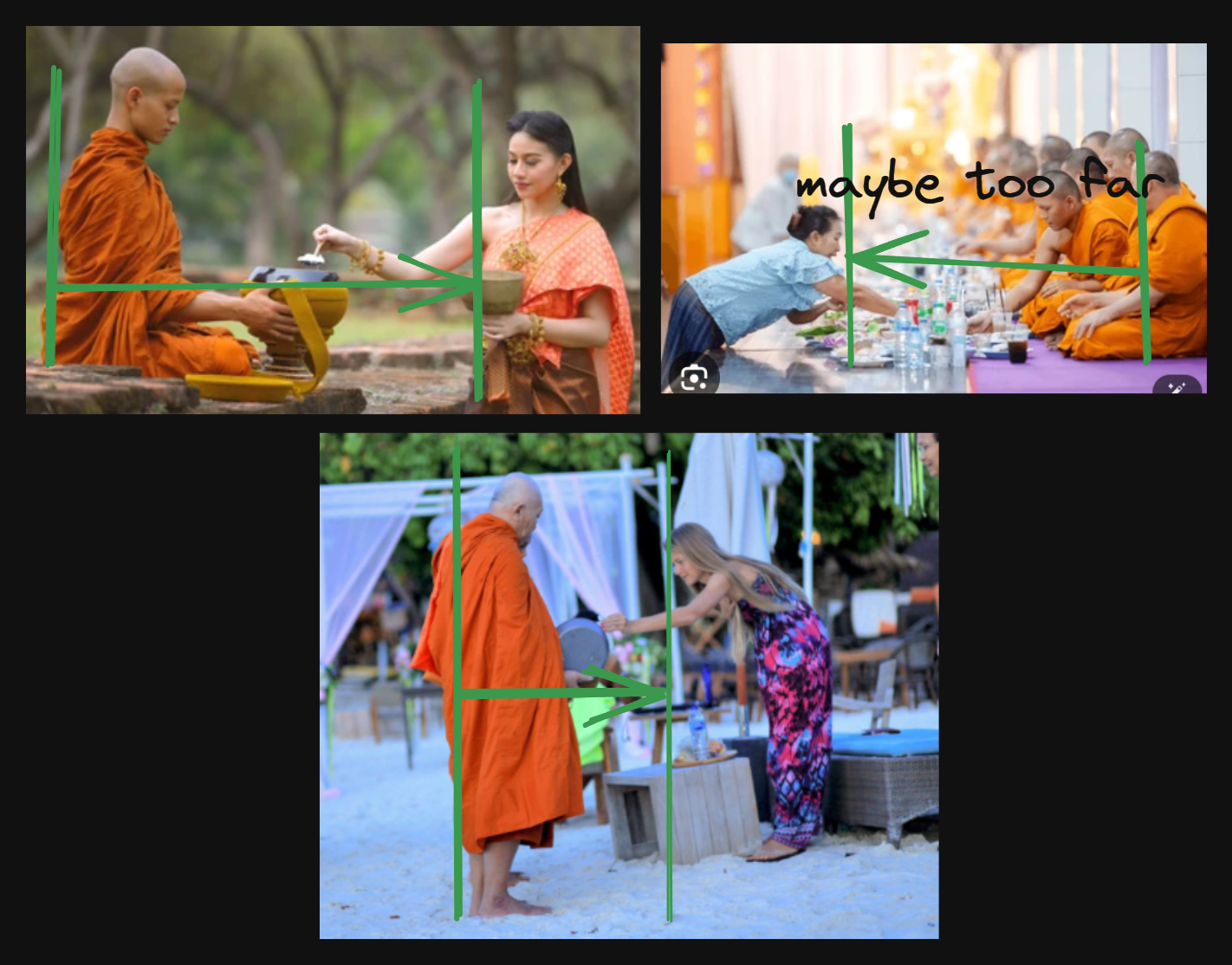
- (kāya) abhiharati: offering bhojana with a bodily gesture
- does verbal offering lead to pavāraṇā?
- vācābhihāra↔verbal offering‒not a factor for pavāraṇa
- kāyābhihāra↔the bodily gesture of offering‒a factor for pavāraṇā
- 4 types of kāyabhihāra
- upanāmana: the act of bringing the food item closer to the monk with the intention of offering it
- if the donor just stands, waiting for the monk to take food, does it lead to pavāraṇā?
- apanāmana: tilting the food towards the monk when it is located on the ground or some stand
- donor A, with a patta on his hands, lap, stand, or ground, offers rice without any gesture to monk B who rejects it: no pavāraṇā
the same, but the donor offers tilting the patta: pavāraṇā
- onamana: when a donor is carrying food on his head, his act of lowering the food and slightly bending towards the recipient intending to offer it is onamana
- ukkhipana / uddharaṇa (lifting the food intending to offer it)
- dūtena pesana kathā
- bk A sends food to bk B by bk C saying "take"; bk C stands silently in front of B who rejects: no pavāraṇā (because of A being far away, and C standing silently)
if C says "take": pavāraṇā (but some teachers and srtdpn say that it is only so if C does kāyābhihāra)
- Therāsane nisinno thero dūre nisinnassa daharabhikkhussa pattaṃ pesetvā "ito odanaṃ gaṇhāhī"ti vadati, gaṇhitvā pana gato tuṇhī tiṭṭhati, daharo "alaṃ mayha"nti paṭikkhipati, na pavāreti. Kasmā? Therassa dūrabhāvato dūtassa ca anabhiharaṇatoti. Sace pana gahetvā āgato bhikkhu "idaṃ bhattaṃ gaṇhā"ti vadati, taṃ paṭikkhipato pavāraṇā hoti. (V-a. III. 92.). Hatthapāsato bahi ṭhitassa satipi dātukāmābhihāre paṭikkhipantassa dūrabhāveneva pavāraṇāya abhāvato therassapi dūrabhāvamattaṃ gahetvā pavāraṇāya abhāvaṃ dassento "therassa dūrabhāvato"ti āha, na pana therassa abhihārasabbhāvato. Sacepi gahetvā gato hatthapāse ṭhito hoti, kiñci pana avatvā ādhārakaṭṭhāne ṭhitattā abhihāro nāma na hotīti "dūtassa ca anabhiharaṇato"ti vuttaṃ. "gahetvā gatena ‘Bhattaṃ gaṇhathā’ti vutte abhihāro nāma hotīti ‘Sace pana gahetvā āgato bhikkhu…pe… pavāraṇā hotī’ti vutta"nti tīsupi gaṇṭhipadesu vuttaṃ. Keci pana "pattaṃ kiñci upanāmetvā ‘Imaṃ bhattaṃ gaṇhathā’ti vuttanti gahetabba"nti vadanti, taṃ yuttaṃ viya dissati vācābhihārassa idha anadhippetattā. (Srd-ṭ. III. 61.).
- why does the thera being far away make a difference? #q🙋🏼♂
- parivesana kathā
- the donor holds a container of bhojana on one hand and offers it with a spoon on the other hand; he enters the hatthapāsa intending to offer (abhihāra or not?): abhihāra
the monk rejects: pavāraṇā
donor A holds the container while donor B just touches it; donor A enters hatthapāsa intending to offer and offers (abhihāra or not?): abhihāra (holder and offerer are the same)
the monk rejects: pavāraṇā
donor B holds the container while donor A offers; entering the hatthapāsa intending to offer (abhinihāra or not?): no, only when kāyābhihāra is done‒e.g.: the bhojana is taken with the spoon and lifted (ukkhipana)
the monk rejects: not pavāraṇā
while a donor offers to monk A, monk B, sitting nearby, covers his patta: no pavāraṇā, since the offering was intended to monk A
- Anantarassa bhikkhuno bhatte diyyamāne itaro pattaṃ hatthehi pidahati, pavāraṇā natthi. Kasmā? Aññassa abhihaṭe paṭikkhittattā. (V-a. III. 93.).
- patikkhepo paññāyati: refusal by the bhikkhu‒2 types
- kāyapaṭikkhepa (bodily refusal): any bodily action intended on refusing‒even just looking angrily at the donor
- vācāpaṭikkhepa (verbal refusal): saying “Enough”, “I don’t take”, “Do not serve” or “Go away”, etc intending to refuse
- is saying "Please serve having pounded" paṭikkhepa?
- mahāsummatthera: paṭikkhepa, since the intention was to stop the serving (prioritizing the intention)
- mahāpadumatthera: no, as the monk asked the donor to serve, not to stop (prioritizing the wording)
- is saying "Please, wait" and asking another monk "Āvuso, please bring a plate" paṭikkhepa?
- mhsmtr: paṭikkhepa, as the donor’s arrival (gamana) was stopped initially
- mhpdmth (preferred): no; his argument is “Where does the donor arrive? What is his arrival like? Is there pavāraṇā to one who takes?
- what does it mean? #q🙋🏼♂
- what if the donor does not see / understand the refusal? #q🙋🏼♂
- after pavāraṇā
- 3 ways a monk could eat yāvakālika after pavāraṇā till noon / majjhaṇha of that day
- eating‒even newly offered food‒without changing the posture (iriyāpatha) in which pavāraṇā occurred
- 5 iriyāpathas here
- sitting, standing, walking, lying and squatting
- note: changing directions does not break the posture; while lying, one may roll in the same location, but not to another location; a short stool may be given to one squatting
- eating vinayakammātiritta
- eating gilānātiritta
- anatiritta bhojana↔non-leftover yāvakālika
- atiritta bhojana↔leftover yāvakālika‒either vinayakammātiritta or gilānātiritta (not leftover food that remains after dāna)
- 2 types of atiritta bhojana
- vinayakammātiritta: food that is made leftover through a minor vinayakamma
- gilānātiritta: leftover food from what is brought for or consumed by a sick monk
- 8 characteristics of atiritta (7 for vinayakammātiritta and 1 for gilānātiritta)
- kappiyakataṃ hoti: it must be allowable; if bhūtagāma / bījagāma, it must be be made allowable by one of the five samaṇakappa
- paṭiggahitakataṃ hoti: it must have been properly accepted‒the pavārita monk cannot accept it intending to eat it (dkṭ), only intending to make it atiritta (anāpatti)
- hatthapāse kataṃ hoti: pavārita and vinayakamma monk must be within hatthapāsa
- uccāritakataṃ hoti: it must be served by the pavārita monk to the monk who is going to perform the vinayakamma
- bhuttāvinā kataṃ hoti: vinayakamma monk must be bhuttāvī
- if he is bhuttāvī from eating his own food, it seems unnecessary for him to eat the food of the pavārita monk
- bhuttāvinā pavāritena āsanā avuṭṭhitena kataṃ hoti: if vinayakamma monk is also pavārita, he must not have broken his posture
- "Alametaṃ sabba"nti vuttaṃ hoti: this must be said
note: 2 possible meanings‒"this food is enough for me" (preferred), or "this food is enough for you"
- gilānātirittaṃ hoti: (definition)
- atiritta vinayakamma
- pavārita monk takes kappiya paṭiggahita food, enters the hatthapāsa of another monk (B), and while holding it doing uccārita, says: "atirittaṁ karotha, bhante"
B takes at least a grain of rice, eats it (bhuttāvī), hands the bowl back, saying: "alametaṁ sabbaṁ"
that food becomes vinayakamma atiritta
- note:
- B must be bhuttāvī, so if he isn't, he must eat at least a little (normally done); but if he has already eaten from his bowl, he need not eat at all
- if B eats from one container, he need not eat from other containers if they need vinayakamma
- could one become pavāraṇā during the vinayakamma? #q🙋🏼♂
- if one has eaten, but broken the posture, is one still bhuttāvī?
practical tips
- it seems that monks did not used to consume 2 meals; maybe porridge or sweets in the early morning;
practical ways of avoiding pavāraṇā‒
- get everything offered and then serve oneself
- rejecting or covering the bowl before the donor enters the hatthapāsa
- allowing the donor to serve
āpatti
- pavārita monk changes posture and accepts anatiritta food intending to eat it: dkṭ
consuming it: pc for every swallow
if he accepts yāmakālika, sattāhakālika or yāvajīvika for āhārattha: dkṭ
consuming it: dkṭ for every swallow
anāpatti
- atirittaṃ kārāpetvā bhuñjati
- "atirittaṃ kārāpetvā bhuñjissāmī"ti paṭiggaṇhāti: accepting while intending to make it atiritta
- aññassatthāya gaṇhantassa: accepting / taking for someone else
- gilānassa sesakaṃ bhuñjati: for eating gilānātiritta
- yāmakālikaṃ sattāhakālikaṃ yāvajīvikaṃ sati paccaye paribhuñjati
intention and perception
- this is acittaka, nosaññāvimokkha offence
- this is a tika-pācittiya and duka-dukkaṭa offence; saññās involved are anatiritta / atiritta saññā
- pavārita consuming anatiritta
anatirittasaññī: pc
vematiko: pc
atirittasaññī: pc
pavārita consuming atiritta
anatirittasaññī: dkṭ
vematiko: dkṭ
atirittasaññī: anāpatti
factors
- ...pavārito...: having done pavāraṇā
- ...anatirittaṁ khādanīyaṁ vā bhojanīyaṁ vā...: a khādanīya or a bhojanīya which is not an atiritta
- ...khādeyya vā bhuñjeyya vā...: consuming it before noon on the same day that pavāraṇā was performed
- Pāli
- Yo pana bhikkhu bhuttāvī pavārito anatirittaṃ khādanīyaṃ vā bhojanīyaṃ vā khādeyya vā bhuñjeyya vā, pācittiyaṃ.
If any bhikkhu who has eaten \[a meal], who has been invited \[to take more and refused], should chew uncooked food or eat cooked food which is not left over, \[this is a case] involving expiation.
vocab: #\[\[pāḷi vocab (2nd year)]]
- Pacchima (adj.)↔latest; hindmost; lowest; western.
- Paṭṭhāya (ind.)↔beginning with; henceforth; from the time of.
- Paṇhi (m.)↔the heel.
- Passa (m.; nt.)↔side; flank.
- Pārima (adj.)↔yonder; farther.
- Ṭhapetvā (abs. of ṭhapeti)↔having placed; set aside, or left.
- Pasārita (pp. of pasāreti)↔stretched out.
- Āsanna (adj.)↔near. (nt.), neighbourhood.
- Orima (adj.)↔the lowest; one on this side.
- Paricchindati (pari + chid + ṃ-a)↔marks out; limits; defines.
- Nipanna (pp. of nipajjati)↔laid down; slept.
- parivesanā \[pari + √vis + \*anā]↔fem. offering of food; food distribution
- asana \[√as + ana]↔nt. eating; feeding on 1.2 nt. food; lit. eating 2.1 nt. arrow; lit. throwing 3.1 nt. tree Pentaptera Tomentosa
- vippakatabhojano↔one who has not yet finished eating‒one who has bhojana that is intended to be consumed in the next minutes in one's mouth, hands, or bowl
- vippakata \[vi + pa + √kar + ta]↔pp. interrupted; unfinished
extra notes:
- after having done the vinayakamma once, if more food is offered in the same container: it should be redone; but it cannot be redone with the same monk since he refused the food
if more food is offered in another container: it should be redone, it can be done with the same monk or another
- can the monk who does the vinayakamma later eat that same food?
- no, because he has refused it (alametaṁ sabbaṁ)
- note: this is an argument for the meaning of the sentence being this is enough "for me", not "for you"
- how to do the vinayakamma with multiple vessels?
- multiple vessels need multiple kammas
- who can eat vinayakammātiritta food?
- any monk but the one who did the vinayakamma
- khalupacchābhattikaṅga - dhutaṅga related to pavāraṇā
summary based on the Pāḷi
- bhuttāvī: ate at least a little bit of bhojana (a grain of rice)
- pavārito
- 2 meanings of pavāraṇā: invitation and refusal
- rejecting allowable bhojanas (odana, kummāsa, sattu, maccha, maṁsa)
- 5 factors:
- asanaṁ paññāyati (bhuttāvī)
- bhojanaṁ paññāyati (bhojana in mouth, hand, or bowl intending to eat)
- hatthapāse ṭhito, (2 1/2)
- nisinno: āsanassa pacchimantato paṭṭhāya
- ṭhito: paṇhi antato paṭṭhāya
- nipanno: yena passena nipanno, tassa pārimantato paṭṭhāya
- dāyakassa: closest body part except the offering arm
- abhihāra
- kāyābhihāra
- upanamana
- apanamana
- onamana
- ukkhipana / uddharaṇa
- vācābhihāra‒not a factor
- paṭikkhepa
- kāyapaṭikkhepa
- vācāpaṭikkhepa
- anatirittaṃ khādanīyaṃ vā bhojanīyaṃ vā
- vinayakammātiritta
- kappiya, paṭiggahita, uccārita, hatthapāsa, bhuttāvinā, āsanā avuṭṭhitena, alametaṁ sabbanti vuttaṁ (one kamma for each container)
- paṭiggahita
- "atirittaṃ kārāpetvā bhuñjissāmī"ti paṭiggaṇhāti: anāpatti
- aññassatthāya gaṇhantassa: accepting / taking for someone else
- gilānātiritta
- khādeyya vā bhuñjeyya vā (after having broken the posture (5 postures))
- yāmakālikaṃ sattāhakālikaṃ yāvajīvikaṃ sati paccaye paribhuñjati: anāpatti
- acittaka, nosaññāvimokkha
- tikapācittiya, dukadukkaṭa (atiritta / anatirittasaññā)
- pācittiyaṃ.
- accepting food after changing posture intending to eat it: dkṭ
- eating it: pc for every swallow
- if non-yāvakālika for āhārattha: dkṭ
dutiyapavāraṇāsikkhāpadaṃ
background
- Buddha in Jetavana; 2 monks travelling; one reproached the other for something he shouldn't have done; the reproached held a grudge and later insisted on the other eating food after having done pavāraṇā; he then insulted him for doing so
description
- āsādanāpekkhatā↔intention of accusing (here, of eating anatiritta yāvakālika food after pavāraṇā)
- serving a pavārita monk anatiritta yāvakālika with āsādanapekkhatā: dkṭ
if the pavārita accepts it intending to eat it: dkṭ for the giver
if the pavārita eats it: the giver incurrs a dkṭ for his every swallow, and a pc at the end
offering yāma-, sattāha-kālikas or yāvajīvikas for āhārattha: the same offenses but no pc at the end
if the pavārita doesn't know it is anatiritta: offenses for the giver all the same
anāpatti
- atirittaṃ kārāpetvā deti: if it is atiritta
- can it be made atiritta by a monk who is not pavārita? #q🙋🏼♂
- "atirittaṃ kārāpetvā bhuñjāhī"ti deti: if the giver tells the pavārita to make it atiritta
- aññassatthāya haranto gacchāhīti deti: if it is to be taken to another monk
- gilānassa sesakaṃ deti: if it is gilānātiritta
- "yāmakālikaṃ sattāhakālikaṃ yāvajīvikaṃ sati paccaye paribhuñjā"ti deti: if non-yāvakālikas are given not for āhārattha
intention and perception
- this is sacittaka saññāvimokkha offence
- this is ekaka-pācittiya and tika-dukkaṭa offence; the perception involved is pavārita saññā and appavārita saññā
- (should be confirmed)
offering to a pavārita monk
pavāritasaññī: pc
vematiko: dkṭ
appavāritasaññī: anāpatti
offering to a non-pavārita monk
pavāritasaññī: dkṭ
vematiko: dkṭ
appavāritasaññī: anāpatti
factors
- ...bhikkhuṁ bhuttāviṁ pavāritaṁ...: monk A being pavārita (pavāritatā)
- ...anatirittena khādanīyena vā bhojanīyena vā abhihaṭṭhuṃ pavāreyya...: monk B offering anatiritta food (anatirittena abhihaṭṭhuṃ pavāraṇā)
- ...jānaṁ...: monk B knowing the pavārita status of monk A (pavāritasaññitā)‒either by seeing it, hearing about it from someome else, or hearing about it from the pavārita monk himself
- ...āsādanāpekkho...: monk B having the itention to criticize A (āsādanāpekkhatā)
- ...bhuttasmiṁ...: monk A finishing the meal (bhojanapariyosānaṃ)
- Pāḷi
- Yo pana bhikkhu bhikkhuṃ bhuttāviṃ pavāritaṃ anatirittena khādanīyena vā bhojanīyena vā abhihaṭṭhuṃ pavāreyya handa bhikkhu khāda vā bhuñja vāti, jānaṃ āsādanāpekkho bhuttasmiṃ pācittiyaṃ.
If any bhikkhu, knowingly \[and] desiring to cause offence, should invite a bhikkhu, who has eaten \[a meal and] who has been invited \[to take more], to take uncooked food or cooked food which is not left over \[saying]: “Here, bhikkhu, chew and eat!,” when \[the food] has been eaten, \[this is a case] involving expiation.
summary based on the Pāḷi
- bhikkhuṃ bhuttāviṃ pavāritaṃ
- anatirittena khādanīyena vā bhojanīyena vā
- "atirittaṃ kārāpetvā bhuñjāhī"ti deti: anāpatti
- aññassatthāya haranto gacchāhīti deti: if it is to be taken to another monk‒anāpatti
- gilānassa sesakaṃ deti: if it is gilānātiritta‒anāpatti
- "yāmakālikaṃ sattāhakālikaṃ yāvajīvikaṃ sati paccaye paribhuñjā"ti deti: if non-yāvakālikas are given not for āhārattha‒anāpatti
- jānaṃ: the giver knows the recipient is pavārita
- sacittaka saññāvimokkha
- ekakapācittiya, tikadukkaṭa (pavārita / appavārita saññā)
- the perception of the recipient is irrelevant
- āsādanāpekkho: desire to criticize him
- bhuttasmiṃ: the recipient consuming it
- pācittiyaṃ.
- serving: dkṭ
- pavārita monk consumes it: dkṭ for every swallow, and pc at the end (for the giver)
- offering non-yāmakālika: dkṭ
vikālabhojanasikkhāpadaṃ
background
- Buddha in Veḷuvana; drama called Giraggasamajja in Rājagaha; sattarasavaggiya bhikkhus watched it; people took care of them and gave them food; they offered it to the chabbaggiyas, who then criticized them for having eaten in the vikāla; Buddha laid down the rule
description
- in the early days, no rule; Buddha advised them to eat one meals before noon (ekabhattika); background story happened;
- accepting food in the vikāla intending to consume it: dkṭ
consuming it: pc for every swallow
accepting yāma-, sattāha-, and yāvajīvika for āhāratthāya: dkṭ
consuming it: dkṭ for every swallow
accepting yāvakālika in the vikāla thinking it is non-yāvakālika: dkṭ
consuming it: pc for every swallow
- bhattuggāra comes up but does not enter the mouth and one eats yāvakālika: anāpatti
it comes up and enters the mouth; one swallows: pc for every swallow
food between the teeth; taste is present; one swallows it without being aware: pc
being aware: pc
if the particles are very small and there is no taste: abbhohārika, anāpatti
- should one wash the mouth before noon?
- the mouth should be rinsed with water before noon; if water is not available, one should spit 2 or 3 times after hawking (kakkhāretvā) and then find water to rinse the mouth
anāpatti
- yāmakālikaṃ sattāhakālikaṃ yāvajīvikaṃ sati paccaye paribhuñjati: eating non-yāmakālika during the vikāla for a vald reason (not as food)
- suitable reasons to consume yāmakālika
- pipāsattha: thirst
- while experiencing syncope (fainting)
- shortness of breath
- can it be consumed for bhesajjattha? #q🙋🏼♂
- suitable reasons to consume sattāhakālika and yāvajīvika
- bhesajattha: for a sickness
intention and perception
- this is acittaka, nosaññāvimokkha offence
- this is a tika-pācittiya and duka dukkaṭa offence
perceptions involved are vikāla saññā and kāla saññā
- vikāle
vikālasaññī: pc
vematiko: pc
kālasaññī: pc
kāle
vikālasaññī: dkṭ
vematiko: dkṭ
kālasaññī: anāpatti </li>
</ul>
</li>
puggalodissa anuññāta
- Romanthakabhikkhu↔a monk that regurgitated food often (he had been born as a bull many times and developed the habit of ruminating)
- allowance for Romanthakabhikkhu
- anujānāmi, bhikkhave, romanthakassa romanthanaṃ (ruminating).
Na ca, bhikkhave, bahimukhadvāraṃ (outside the mouth) nīharitvā (bring it out) ajjhoharitabbaṃ (swallow). Yo ajjhohareyya, yathādhammo kāretabbo.
- what does "yathādhammo kāretabbo" mean?
- it should be done in accordance with the dhamma‒it always refers to a pācittiya offense
- if Romanthakabhikkhu ruminates food that came up to his mouth: anāpatti
if he brings it out of his mouth and then swallows it again: pc
if other bhikkhus ruminate: āpatti
swallowing the undigested food due to lack of control: anāpatti
- Romanthakassāti ettha ṭhapetvā romanthakaṃ sesānaṃ āgataṃ uggāraṃ mukhe sandhāretvā gilantānaṃ āpatti. Sace pana asandhāritameva paragalaṃ gacchati, vaṭṭati. (V a. IV. 53.).
- what should be done if undigested food / stomach juice flows back to the mouth?
aṅga
- ...vikāle...(vikālatā)
- ...khādanīyaṃ vā bhojanīyaṃ vā...(yāvakālikatā)
- ...khādeyya vā bhuñjeyya vā...(ajjhoharaṇaṃ): swallowing
- Pāḷi
- Yo pana bhikkhu vikāle khādanīyaṃ vā bhojanīyaṃ vā khādeyya vā bhuñjeyya vā, pācittiyaṃ.
If any bhikkhu should chew uncooked food or eat cooked food at the wrong time, \[this is a case] involving expiation.
vocab: #\[\[pāḷi vocab (2nd year)]]
- bhattuggāra↔undigested food (reflux)
- avisayatā↔nature of being beyond the control of the monk; out-of-range-ness
- kakkhāretvā↔having hawked (?) (to spit noisily cleaning the throat)
- puggalodissa anuññātaṁ↔permission given to a specific individual (like to Romanthakabhikkhu)
map of the rule based on the Pāḷi
- vikāle
- khādanīyaṃ vā bhojanīyaṃ vā
- khādeyya vā bhuñjeyya vā: swallowing past the pharynx
- pācittiyaṃ.
- yāvakālika:
- accepting: dkṭ
consuming: pc
- if yāma-, sattāha-, or yāvajīvika
- accepting: dkṭ
- consuming: dkṭ
- puggalodissa anuññāta for romanthakabhikkhu
sannidhikārakasikkhāpadaṃ
background
- Buddha in Jtvn; V. Bellaṭṭhasīsa (V. Ānanda's teacher) brought sukkhakura and had novices dry it, store it, and offer it to him when he needed; he went piṇḍapāta only once every few weeks; Buddha reprimanded him and laid down the rule
description
- what should be done with surplus yāvakālika and yāmakālika?
- nirāpekkhadāna: give it away to anupa without expectation of getting it back
- or anapekkhavissajjana: relinquish the paṭiggahaṇa without expectation
- sannidhikāraka / sannidhikāra↔a yāvakālika or yāmakālika that was accepted and kept overnight
“Sannidhikārameva sannidhikārakaṃ. Paṭiggahetvā ekarattaṃ vītināmitassetaṃ adhivacanaṃ”.
- collecting a sannidhikāraka item intending to consume it: dkṭ
consuming it: pācittiya for every swallow
- pcpāḷi: Khādissāmi bhuñjissāmīti paṭiggaṇhāti (collecting) āpatti dukkaṭassa
- here, paṭiggaṇhāti means collecting, since it is already accepted
- Sannidhikārakanti kāro karaṇaṃ kiriyāti atthato ekaṃ, sannidhi kāro assāti sannidhikāraṃ, sannidhikārameva sannidhikārakaṃ, paṭiggahetvā ekarattiṃ vītināmitassetaṃ nāmaṃ. Tasmā evaṃ sannidhikataṃ yaṃkiñci yāvakālikaṃ vā yāmakālikaṃ vā ‘Ajjhoharissāmī’ti gaṇhantassa paṭiggahaṇe dukkaṭaṃ, ajjhohāre ajjhohāre pācittiyaṃ. (Kṅk. 225.).
- Paṭiggaṇhāti āpatti dukkaṭassāti evaṃ sannidhikataṃ yaṃkiñci yāvakālikaṃ vā yāmakālikaṃ vā ajjhoharitukāmatāya gaṇhantassa paṭiggahaṇe tāva āpatti dukkaṭassa. (V-a. IV. 104.).
- Paṭiggahaṇeti gahaṇameva sandhāya vuttaṃ. Paṭiggahitameva hi taṃ, puna paṭiggahaṇakiccaṃ natthi. Teneva "ajjhoharitukāmatāya gaṇhantassa paṭiggahaṇe"ti vuttaṃ. Mātikāṭṭhakathāyaṃ (kaṅkhā. Aṭṭha. Sannidhikārakasikkhāpadavaṇṇanā) pana "ajjhoharissāmīti gaṇhantassa paṭiggahaṇe"icceva vuttaṃ. (Srd-ṭ. III. 67.).
- how to prevent an accepted item from becoming sannidhi?
- its paṭiggahaṇa nature (the nature of having been properly accepted) must be abandoned by either pariccajana (nirāpekkhadāna) or anapekkhavissajjana (relinquishing without expectation of getting it back)
- paṭiggahaṇa
- the nature of having been properly accepted with kāya or kāyapaṭibaddha
- paṭiggahita
- the edible that has been properly accepted with kāya or kāyapaṭibaddha (and other conditions as well)
- appaṭiggahita
- the edible that has not been properly accepted with kāya or kāyapaṭibaddha; it can be one's belonging or not
- pariccajana
- the giving away of the yāva- or yāma-kālika to an anupa
- 2 types of pariccajana (dāna)
- sāpekkhadāna: giving it to an anupa with the expectation of getting it back‒it does not abandon the paṭiggahaṇa
- yāva- or yāma-kālika is given away with sāpekkhadāna and is stored over night: sannidhi, because the paṭiggahaṇa was not removed
receiving such item from an anupa the following day intending to eat it: dkṭ
consuming it: pc for every swallow
- can arahats store food for future use?
- no, it is not possible; V. Bellaṭṭhasīsa gave it away, but expecting to consume it when needed
- nirapekkhadāna: giving it to an anupa without expectation of getting it back‒it does abandon the paṭiggahaṇa
- receiving an edible that was sannidhi and given away with nirāpekkhadāna: anāpatti
consuming it: anāpatti
giving nirāpekkhadāna knowing one might / will get it back: no problem, it is still nirāpekkha
if expectation arises after doing the dāna: no problem, it is still nirāpekkha
- vissajjana↔the relinquishing of the paṭiggahaṇa of a yāva- or yāma-kālika
- anapekkhavissajjana
- the mental giving up of the paṭiggahaṇa of the yāma- or yāva-kālika, intending not to consume it based on the present paṭiggahaṇa
- doing anapekkhavissajjana, receiving the yāma- or yāva-kālika on a later occasion, and consuming it: anāpatti (srtdpn)
- Yaṃ paṭiggahetvā apariccattameva hi dutiyadivase na vaṭṭatīti ettha paṭiggahaṇe anapekkhavissajjanena anupasampannassa nirapekkhadānena vā vijahitapaṭiggahaṇaṃ pariccattameva hotīti "apariccatta"nti iminā ubhayathāpi avijahitapaṭiggahaṇameva vuttaṃ. Tasmā yaṃ parassa pariccajitvā adinnampi sace paṭiggahaṇe nirapekkhavissajjanena vijahitapaṭiggahaṇaṃ hoti, tampi dutiyadivase vaṭṭatīti veditabbaṃ. (Srd-ṭ. III. 67.).
- does anapekkhavissajjana suffice to avoid sannidhi?
- srtdpn: yes, there is no sannidhi and it can be consumed on another day after being offered
- note:
- vmtvndn: no
- some Myanmar teachers do not like srtdpn's idea
- it avoids sannidhi, but for it to be consumed the next day, it has to be nirapekkhadāna based on the fact that when one gives the bowl to an anupa to wash, if food is left in the bowl and gets mixed with next day's food, it is a pc
- whose idea is this? #q🙋🏼♂
- if food is left in the bowl, mixed with next day's food, and one consumes it: pc
- is giving the bowl to an anupa to wash considered anapekkhavissajjana or nirāpekkhadāna? #q🙋🏼♂
- pariccatta / vijahitapaṭiggahaṇa↔yāma- or yāva-kālika of which the paṭiggahaṇa was relinquished‒either by nirapekkhadāna or anapekkhavissajjana (srtdpn-ṭ)
- apariccatta / avijahitapaṭiggahaṇa↔yāma- or yāva-kālika of which the paṭiggahaṇa was not relinquished
- Sayaṃ paṭiggahetvā apariccattameva hi dutiyadivase na vaṭṭatīti ettha paṭiggahaṇe anapekkhavissajjanena anupasampannassa nirapekkhadānena vā vijahitapaṭiggahaṇaṃ pariccattameva hotīti "apariccatta"nti iminā ubhayathāpi avijahitapaṭiggahaṇameva vuttaṃ.
- note: the words pariccajana and vissajjana are interchangeable; here, it follows sāratthadīpanī's usage
- santaka appaṭiggahita (unaccepted belonging)↔food that belongs to a monk, but is not paṭiggahita (not properly accepted with kāya or kāyapaṭibaddha)
- when one is offered food that can be kept for a long time, how can one make it a santaka appaṭiggahita?
- the monk should hand it over to an anupa without touching it; it can then be properly accepted and consumed on later days
- can a monk have santaka appaṭiggahita food moved, given away, etc?
- yes, but not by touching it
- does santaka appaṭiggahita become sannidhi?
- no, because it does not have the paṭiggahaṇa nature
- antovuttha↔santaka appaṭiggahita yāma- or yāva-kālika that was stored overnight in a vāsāgāra of a bhikkhu(s), or of the saṅgha
- consuming antovuttha: dkṭ for every swallow
if santaka appaṭiggahita is stored overnight in an unallowable place: antovuttha
if the ownership is given to anupa and it is stored in an unallowable place: not antovuttha
- anivāsageha↔a building that was not built as a dwelling place; e.g.: uposathāgāra
- Vihāraṃ ṭhapetvāti upasampannānaṃ vāsatthāya katagehaṃ ṭhapetvāti attho. Gehanti nivāsagehaṃ, tadaññaṃ pana uposathāgārādi sabbaṃ anivāsagehaṃ catukappiyabhūmivimuttā pañcamī kappiyabhūmi. Saṅghasantakepi hi etādise gehe suṭṭhu parikkhittārāmattepi abbhokāse viya antovutthādidoso natthi. Yena kenaci channe, paricchanne ca sahaseyyappahonake bhikkhusaṅghassa nivāsagehe antovutthādidoso, na aññattha. Tenāha "yaṃ panā"tiādi. (Vmv-ṭ. II. 190.).
- 2 ways to deal with santaka appaṭiggahita
- to keep the ownership, but have an anupa store it in an allowable place (kappiyabhūmi)
- to give the ownership to an anupa; the anupa can store it anywhere
- is it ok to do so having the expectation of getting it later?
- yes, because the monk's ownership is broken, and the item belongs to the anupa, whose properties do not become antovuttha
- this looks like sāpekkhadāna, but here the item is appaṭiggahita
- if the item were paṭiggahita and one gave it away with sāpekkha, the paṭiggahaṇa would not be broken and it would become sannidhi; but here, the item is appaṭiggahita, so a sāpekkhadāna works
- giving an antovuttha as a sāpekkhadāna, receiving it back and consuming it: it loses the antovuttha status and can be consumed
giving a paṭiggahita yāva- or yāma-kālika on the following day (sannidhi) as a sāpekkhadāna, receiving it back and consuming it: āpatti
- Anupasampannassa dātabbo assātiādinā akappiyakuṭiyaṃ vutthampi (when kept in an akappiyakuti) anupasampannassa dinne (when given to an anupa) kappiyaṃ hoti (becomes allowable), sāpekkhadānañcettha vaṭṭati (can give with expectation), paṭiggahaṇaṃ viya na hotīti dasseti (it is not like paṭiggahaṇa). (Vmv-ṭ. II. 190.).
- which āpatti? #q🙋🏼♂
- bhūmis in which santaka appaṭiggahita can be stored in (1 akappiya and 5 kappiya)
- 1 akappiyabhūmi (prohibited buildings)
- vāsāgāra (dwelling place) of a bhikkhu(s) / the saṅgha: becomes antovuttha
- 5 kappiyabhūmi (allowed buildings)
- saṅghika / puggalika anivāsageha (vmtvndn-ṭ): a building that was not build as a dwelling place for a monk(s), or the saṅgha
- ussāvanantikā: a building made as a kappiyakuṭi to store food by a vinayakamma in which the placement of the first stone / pillar has to be done simultaneously with the recital of the sentence
- gonisādikā: a kuṭi in an aparikkhitta monastery (not bounded)
- go from cow: not allowing cows to enter
- note: the kuṭi being unprotected is better in this case, to discourage the storing of food
- gonisādikā duvidhā – ārāmagonisādikā, vihāragonisādikāti. tāsu yattha neva ārāmo na senāsanāni parikkhittāni honti, ayaṃ "ārāmagonisādikā" nāma. yattha senāsanāni sabbāni vā ekaccāni vā parikkhittāni, ārāmo aparikkhitto, ayaṃ "vihāragonisādikā" nāma.
- gahapati (5 types)
- a dwelling belonging to a householder
- a dwelling built or being built for monks / saṅgha, but still unoffered, and still belonging to the donor (vmtvndn)
- a dwelling offered by a householder as a kappiya kuṭi
- note: legality is not what counts here; if the donor offers it verbally, it is enough
- for bhikkhus: a vāsāgāra of bhikkhunīs
- for bhikkhunīs: a vāsāgāra of bhikkhus
- "Saṅghikaṃ vā puggalikaṃ vā"ti idaṃ kiñcāpi bhikkhunīnaṃ sāmaññato vuttaṃ, bhikkhūnaṃ pana saṅghikaṃ puggalikañca bhikkhunīnaṃ, tāsaṃ saṅghikaṃ puggalikañca bhikkhūnaṃ gihisantakaṭṭhāne tiṭṭhatīti veditabbaṃ. (Vmv-ṭ. II. 190.).
- sammuti: a building that was made as a kappiyakuṭi through a vinayakamma
- extra notes:
- kuṭi offering
- "yathā sukhaṁ paribhuñjati"‒can be used according to one's wish
- kuṭis in iit were offered with yathāsukhaṁ paribhuñjati
- the intention of the donor is what counts during the donation, if they say "saṅghassa dema" but they intend it to be, say, bhikkhunī saṅgha's, it is so
- extra notes:
- related story: V. Karavikatissa's advice
- it seems that, according to the story, if it is antovuttha and kept outside the kuṭi, it would become allowable, but this is not discussed
- sannidhikāraka in the bowl
- if remnants of the previous day's food are mixed with the following day's food and consumed: pc for every swallow
- why is it an offense, if the food was pariccatta on the previous day?
- ancient gaṇṭhipadas: it doesn't lose the paṭiggahaṇa; it is not properly relinquished, so it becomes sannidhi
- Yadi evaṃ "patto duddhoto hotī"tiādīsu kasmā āpatti vuttāti? "paṭiggahaṇaṃ avissajjetvāva sayaṃ vā aññena vā tucchaṃ katvā na sammā dhovitvā niṭṭhāpite patte laggampi avijahitapaṭiggahaṇameva hotīti tattha āpattī"ti tīsupi gaṇṭhipadesu vuttaṃ. (Srd-ṭ. III. 67.).
- standards for washed bowls
- after washing it, one should fill it with clean water and look for oil slicks, or draw lines in the inner surface with the finger to check for oil lines
- telavaṇṇapatta (bowl with the color of oil): naturally shows lines when touched with the finger‒not taken into consideration
- non-telavaṇṇapatta: lines appear when rubbing a finger on the bowl's surface (not properly washed)
- gaṇṭhikapatta (mended): sineha (oil) goes inside the gaṇṭhika (mendings), oozes out when heated, and gets mixed with the food and is visible (not properly washed)
- mixing kālikas
- in terms of how long it can be consumed for, what is the longest edible item?
- akālika (water), as its time period is not limited by the moment of acceptance and death of the monk
- general principles
- the longer kālika becomes like the shorter one
- only the amount mixed changes
- the day of acceptance remains the same
- water (akālika) only changes the kāla of yāmakālika fruit essences and guḷa
- old yāvajīvika can be mixed with sattāhakālika and consumed for 7 days
- note: in some monasteries, it is considered that because the spoon may be returned back to the pot after mixing, the entire pot is considered to be mixed
- yāma-, sattāha-, yāvajīvika, and akālika mixed with yāvakālika: yāvakālika
sattāha, yāvajīvika, and akālika mixed with yāmakālika: yāmakālika
yāvajīvika and akālika mixed with sattāhakālika: sattāhakālika
akālika mixed with yāvajīvika: yāvajīvika
- yāvakālika fruit essence mixed with water: yāmakālika
guḷa is allowed for: the sick
guḷodaka is allowed for: anyone anytime for any reason (a yāvajīvika that can be consumed for any reason)
10 day-old yāvajīvika mixed with a 3 day-old sattāhakālika:
nature: sattāhakālika
for how long can it be consumed? for 4 days (even though it is like a 10 day-old sattāhakālika)
- "Yāvakālikaṃ samānaṃ garutarampi muddikājātirasaṃ attanā saṃsaṭṭhaṃ lahukaṃ yāmakālikabhāvaṃ upanentaṃ udakaṃ lahutaraṃ sattāhakālikaṃ attanā saṃsaṭṭhaṃ garutaraṃ yāmakālikabhāvaṃ upanetī"ti ettha kāraṇaṃ soyeva pucchitabbo, sabbattha pāḷiyaṃ aṭṭhakathāyañca udakasambhedena garutarassapi lahubhāvopagamanaṃyeva dassitaṃ. Pāḷiyampi hi "anujānāmi, bhikkhave, gilānassa guḷaṃ, agilānassa guḷodaka"nti vadantena agilānena paribhuñjituṃ ayuttopi guḷo udakasambhinno agilānassapi vaṭṭatīti anuññāto. (Srd-ṭ. II. 432-3.).
- ghee is put on rice during piṇḍapāta, one takes what is not mixed and uses it as sattāhakālika: allowable
a sattāhakālika accepted yesterday is mixed with a yāvakālika accepted today; of what nature it becomes? yāvakālika that was accepted yesterday
consuming it: pc for every swallow
- what are the only cases where the kāla changes when mixed with water
- offenses
- mixing today's yāvakālika with yāmakālika accepted also today during kāla and consuming it: anāpatti
if with sattāhakālika: anāpatti
if with yāvajīvika: anāpatti
if with akālika: anāpatti
principle: anything that was accepted during the kāla of the same day can be mixed with yāvakālika and consumed
- if yesterday's sattāha- or yāvajīvika is mixed with today's yāvakālika during kāla: sannidhi pc; the mixture is a yāvakālika received yesterday
- mixing sattāha- or yāvajīvika with a yāmakālika received on the same day and consuming it before the dawn of the following day: anāpatti; the mixture is a yāmakālika
if the sattāha- or yāvajīvika were received the previous day: sannidhikāraka pācittiya for every swallow; the mixture is yāmakālika received on the previous day
- mixing an old yāvajīvika with a sattāha- received today and consuming it today: anāpatti; the mixture is like an old sattāhakālika, but is allowed
consuming it the day after: anāpatti, it can be consumed for 7 days
anāpatti
- yāvakālikaṃ yāvakāle nidahitvā bhuñjati: storing and consuming a yāvakālika during the kāla it was received
- yāmakālikaṃ yāme nidahitvā bhuñjati: storing and consuming a yāmakālika during the yāma it was received
- sattāhakālikaṃ sattāhaṃ nidahitvā bhuñjati: storing and consuming a sattāhakālika during the seven days after its acceptance
- yāvajīvikaṃ sati paccaye paribhuñjati
intention and perception
- this is acittaka, nosaññāvimokkha offence; this is a tika-pācittiya and duka dukkaṭa offence;
perceptions involved are
sannidhikāraka saññā and asannidhikāraka saññā
- consuming a sannidhikāraka
sannidhikārakasaññī: pc
vematiko: pc
asannidhikārakasaññī: pc
consuming an asannidhikāraka
sannidhikārakasaññī: dkṭ
vematiko: dkṭ
asannidhikārakasaññī: anāpatti
factors
- ...sannidhikārakaṃ...(sannidhibhāvo)
- ...khādanīyaṃ vā bhojanīyaṃ vā...(yāvakālikatā or also yāmakālikatā)
- the anāpatti section says that a yāmakālika can be consumed if stored during the yāma; based on this passage, the yāmakālika is understood to be included
- ...khādeyya vā bhuñjeyya vā...(ajjhoharaṇaṃ)
- Pāḷi
- Yo pana bhikkhu sannidhikārakaṃ khādanīyaṃ vā bhojanīyaṃ vā khādeyya vā bhuñjeyya vā, pācittiyaṃ.
If any bhikkhu should chew uncooked food or eat cooked food \[while] keeping \[it] in store, \[this is a case] involving expiation.
vocab: #\[\[pāḷi vocab (2nd year)]]
- sukkhakura↔rice without curries
- vītināmita↔pp. spent time; 2 pp. waited
- adhivacanaṁ \[adhi + √vac + ana]↔nt. (+dat) term (for); name (for); expression (for); epithet (of); designation (for)
- guḷa \[√guḷ + a]↔nt. sugar; jaggery; molasses; lit. ball
extra notes:
- mukha sannidhi→antovuṭṭha mixed with yāvakālika or yāmakālika (not clear, confirm) #q🙋🏼♂
paṇītabhojanasikkhāpadaṃ
background
- Buddha in Jtvn; chavaggiyas requested for paṇītabhojana from devotees; people criticized; rule was laid down;
ill monks felt the need for paṇītabhojana; allowance was given for the sick
description
- paṇītabhojana (def)
- 9 sumptuous foods cooked with pubbaṇṇa grains
- 9 paṇītabhojanas
- sappi – rice with ghee from animals whose meat is allowable
- navanīta – rice with butter from animals whose meat is allowable
- tela – rice with either tilatela (sesame oil), sāsapatela (mustard oil), madhukatela (mahua oil/madhuca longifolia), eraṇḍatela (castor oil) or vasātela (animal fat oil)
- could it be any oil? #q🙋🏼♂
- madhu – rice with bee-honey
- phāṇita – rice with sugar cane products (ucchu vikati)
- maccha – rice with flesh of aquatic beings
- maṃsa – rice with allowable meat
- khīra – rice with allowable milk
- dadhi – rice with allowable curd
- note: "rice" could be any bhojana
- gilāna and agilāna
- gilāna: a monk who cannot remain well, who is unconfortable (aphāsu), without having paṇītabhojana
- agilāna: a monk who can remain well, who is not unconfortable (aphāsu), without having paṇītabhojana
- agilāna asking for paṇītabhojana: dkṭ
accepting it: dkṭ
consuming it: pc for every swallow
- 4 manners of requesting included in this rule (exam: English or Pāḷi) #\[\[vibhaṅga exam]] #edited
- sappinā bhattaṃ dehi – give rice with ghee
- sappiṃ ākiritvā bhattaṃ dehi – give rice with ghee poured onto it
- sappimissakaṃ katvā bhattaṃ dehi – give rice having mixed it with ghee
- sappiñca bhattañca dehi – give ghee and rice
- not included: sappibhattaṁ dehi
- is sappibhattaṁ dehi included?
- comm: sappibhattaṁ dehi or navanītabhattaṁ dehi, etc is not included because there is no specific rice known as ghee-rice - addressed under the sūpodanaviññatti sekhiya
- srtdpn: according to grammar it is ok, but comm should be followed here
āpatti
- asking for one paṇītabhojana, but receiving anything capable of producing that item (such as ingredients to make it, allowable requisites, or even a cow \[for producing milk, for example]) and then consuming it: pc for every swallow (yena yena hi viññatti hoti, tasmiṃ vā tassa mūle vā laddhe, taṃ taṃ laddhameva hoti)
asking, receiving and consuming: dkṭ, dkṭ, pc for every swallow
asking for all 9 of them, mixing them and then consuming it: 9 pc for every swallow
asking for paṇītabhojana from sources not mentioned in this rule (such as lion milk), receiving and consuming it: dkṭ each
- agilāna asks for 5 medicines without grains from aññātika appavārita: should be dealt under mahānāmasikkhāpada (acelakavagga)
asking from a pavārita donor but exceeding the invitation: offenses all the same
asking for paṇītabhojanas but without grains: should be dealt under the sūpodanaviññāttisekhiya
visaṅketa
- asking for one thing, but receiving another
- asking for rice with cow-ghee, receiving rice with goat-ghee, consuming it: #\[\[vibhaṅga exam]]
- comm: anāpatti (Aññaṃ yācitena aññaṃ dinnaṃ nāma hoti, tasmā anāpatti)
- srtdpn: anāpatti at all
- vmtvndn and some teachers: anāpatti under this sikkhāpada, but āpatti under sūpodanaviññatti
- some other teachers: anāpatti, but the monk should not consume what he received by wrong effort (preferred by bh)
anāpatti
- gilānassa
- the sick can ask, but can another ask for the sick? #q🙋🏼♂
- gilāno hutvā viññāpetvā agilāno bhuñjati: asking while sick, recovering, and then consuming it while not sick
- gilānassa sesakaṃ bhuñjati: consuming leftover obtained through a request made for another sick monk
- ñātakānaṃ, pavāritānaṃ
- aññassatthāya: request it for another monk either from one's own ñātaka / pavārita donor, or of the other monk's ñātaka / pavārita donor
- attano dhanena: by using one's own wealth
intention and perception
- this is an (acittaka / cittaka?) acittaka, (saññā / nosaññāvimokkha?) nosaññāvimokkha offence
- this is a tika-pācittiya and duka-dukkaṭa offence;
the perceptions involved are agilāna and agilāna saññā (about oneself)
- agilāna asking for paṇītabhojana
agilānasaññī: pc
vematiko: pc
gilānasaññī: pc
gilāna asking for paṇītabhojana
agilānasaññī: dkṭ
vematiko: dkṭ
gilānasaññī: anāpatti
aṅga
- ...paṇītabhojanāni...(paṇītabhojanatā)
- ...agilāno...(agilānatā)
- kataviññattiyā paṭilābho: receiving what one requested for
- ...bhuñjeyya...(ajjhoharaṇaṃ)
- Pāḷi
- Yāni kho pana tāni paṇītabhojanāni, seyyathīdaṃ - sappi navanītaṃ telaṃ madhu phāṇitaṃ maccho maṃsaṃ khīraṃ dadhi. Yo pana bhikkhu evarūpāni paṇītabhojanāni agilāno attano atthāya viññāpetvā bhuñjeyya, pācittiyaṃ.
Those foods which are superior, namely: ghee, butter, oil, honey and molasses, fish, meat, milk, curd; if any bhikkhu, who is not ill, having requested such superior foods for his own benefit, should eat \[them], \[this is a case] involving expiation.
dantaponasikkhāpadaṃ
background
- Buddha in Kuṭāgāra, Vesāli; a sabbapaṁsukūlika monk was living in a cemetery and eating food left on graves (susāna), under trees, or on the entrace of the house made in the cemetery (ummāra); people criticized; rule was laid down; monks had doubt about the dantapona and water; allowance was made
- extra note:
- the Buddha, in some of his past lives as an ascetic, praised eating uncooked food and sustained himself only from what he collected from the ground. But as a leader of the Saṅgha community, he prevented monks from doing so. This shows that practices that maybe beneficial to individuals may not be applicable when it comes to a community.
- what if such practice is not actually beneficial? he practiced all kinds of things, some beneficial, some not #q🙋🏼♂
- ummāra↔masc. threshold; doorway; entrance #\[\[pāḷi vocab (2nd year)]]
description
- 7 types of foods (edibles in general)
- āmaṭṭha↔unoffered edible knowingly touched by an upa
- for whom is it unallowable?
- it is unallowable, but only to the upa who touched it; other upas can get it offered and consume it
- touching it is worse than picking it up? (1st type of uggahita) #q🙋🏼♂
- uggahita↔unoffered edible collected by a monk
- picking it up intending to eat it: dkṭ
consuming it: pc every swallow
- 3 types
- unoffered and knowingly collected
- giving it as a sāpekkhadāna and receiving it back: uggahita paṭiggahita dkṭ
consuming it: dkṭ
giving it as a nirāpekkhadāna and receiving it back: anāpatti
consuming it: anāpatti
- unoffered and collected thinking it is offered
- consuming it knowing it is unoffered: pc
consuming it in doubt: pc
consuming it thinking it is offered: pc
getting it reoffered through an anupa: anāpatti
consuming it: anāpatti
- how to get it offered
- general principle: keep the food in its original place as it was, and get it offered
- if not possible, keep it nearby (ṭhapetvā) and do not touch it again until offered
- if the container was open, one should not close it after placing it back
- if on a staircase, do not keep it in the middle of the staircase, but bring it either to the top or bottom
- Paṭiggahitakaṃ gaṇhissāmīti appaṭiggahitakaṃ gahetvā ñatvā puna ṭhapeti, uggahitakaṃ na hoti. Bahi nīharitvā sañjānāti, bahi aṭṭhapetvā haritvā tattheva ṭhapetabbaṃ, natthi doso. Sace pana pubbe vivaritvā ṭhapitaṃ na pidahitabbaṃ, yathā pubbe ṭhitaṃ tatheva ṭhapetabbaṃ. Sace bahi ṭhapeti, puna na chupitabbaṃ. Heṭṭhāpāsādaṃ orohanto nisseṇimajjhe sañjānāti, anokāsattā uddhaṃ vā adho vā haritvā ṭhapetabbaṃ. (V-a. III. 115.).
- unoffered and collected without knowing it is food
- getting it offered through an anupa: anāpatti
consuming it: anāpatti
- Heṭṭhāmañce appaṭiggahitakaṃ telathālakaṃ hoti, taṃ ce sammajjanto sammuñjaniyā ghaṭṭeti, uggahitakaṃ na hoti. (V-a. III. 115.).
- uggahaṇa↔the act of taking an unoffered edible
- picking up an item from a donor who did not make a gesture of offering (abhihāra): uggahaṇa
if multiple containers and the donor does abhihāra: one should accept the entire thing by touching the bottom-most container
if on a tray: accept the entire thing by touching the tray (normally done on its lower part, but not essential) and pick up the item with the other hand (not essential to maintain contact, but normally done)
- what if the donor does not intend to offer the entire tray, or the entire pile of containers? that factor will not be fulfilled. #q🙋🏼♂
- santaka uggahita↔santaka apaṭiggahita edible collected (uggahita) by the upa who owns it (details under uggahita)
- in which ways is it indirectly offered?
- offered verbally saying something like:
- “Imaṃ bhikkhaṃ bhikkhusaṅghassa dema"‒we give this food to the bhikkhu saṅgha
- “I am giving / offering this to you.", etc
- is it possible by means of gestures or writing?
- uggahita paṭiggahita↔unoffered edible knowingly collected by an upa, and made offered through an anupa with sāpekkhadāna
- when was uggahita paṭiggahita allowed?
- during a famine in Rājagaha; but the allowance was revoked afterwards; now it is a dkṭ
- extra notes:
- according to some scholars:
- 8 reasons for schism not long after the demise of the Buddha:
- antovuttha, antopakkaṃ, sāmaṃ pakkaṃ, uggahitapaṭiggahitaṃ, tato nīhaṭaṃ, purebhattaṃ paṭiggahitaṃ vanaṭṭhaṃ, pokkharaṭṭhaṃ
- mainstream theravādins: exclusive to that particular famine
- during a famine in SL, these rules were not relaxed
- other schools:
- mahiṁsakas: 7 of them could be used during famines
- dharmaguptikas (Dhammaguttiyas): all 8 could be used during famines
- Purāṇatthera is said to be their originator
- it is said he agreed with the first council
- some scholars say he disagreed with certain things: these 8 rules should be relaxed again in other famines
- paṭiggahita↔edibles directly and properly offered to an upa‒allowable for all upa
- abhihaṭa paṭiggahita↔food, soot or ash (or anything) that accidentaly falls on the bowl while the donor is offering food
- is it allowable?
- yes, as all are included in the offering
- Uḷuṅkena āharitvā dentānaṃ paṭhamataraṃ uḷuṅkato thevā patte patanti, supatitā, abhihaṭattā doso natthi. Sacepi carukena bhatte ākiriyamāne carukato masi vā chārikā vā patati, abhihaṭattā nevatthi doso. (V-a. III. 112.).
- pariccatta↔food that falls while the donor was offering it to a monk
- what should be done?
- the recipient upa can collect the item and consume it, though not paṭiggahita
- adinna and dinna
- adinna
- under 2nd Prjk: another's belonging
- under dantaponasikkhāpada: an edible that was not properly offered (equal to appaṭiggahita)
- collecting adinna edible intending to consume it: dkṭ
- dinna
- dinnaṃ nāma kāyena vā kāyapaṭibaddhena vā nissaggiyena vā dente hatthapāse ṭhito kāyena vā kāyapaṭibaddhena vā paṭiggaṇhāti, etaṃ dinnaṃ nāma.
- edible given by:
- body (kāyena)
- something connected to the body (kāyapaṭibaddhena)
- by releasing it (nissaggiyena)
- accepted by:
- body (kāyena)
- something connected to the body (kāyapaṭibaddhena)
- note: it is equal to paṭiggahita
- dāna and paṭiggahaṇa
- 9 factors for dinna / paṭiggahita to be complete
- status
- the dāyaka must be an anupasampanna
- the paṭiggāhaka must be an upasampanna
- an edible offered to a monk by giving it to a sāmaṇera is what?
- it is santaka appaṭiggahita
- mind
- the dākaya's intention of offering accompanied by abhihāra
- dātukāmatāya abhihaṭa
- an edible that is presented by a donor to an upa with kāyābhihāra and intention of offering
- Yassa pattassa upari phālenti, tassa patte patitesu dātukāmatāya abhihaṭattā doso natthi. (V-a. III. 112.).
- the paṭiggāhaka's intention to accept the edible for its consumption
- ābhogaṁ katvā↔having had the thought (of accepting)
- Ābhogamattameva hi ettha pamāṇanti ayaṃ nayo mahāpaccariyaṃ vutto. (V-a. III. 109.).
Ābhogaṃ katvāti "paṭiggahessāmī"ti manasikāraṃ katvā. (Pc.ay. 89.).
- ābhoga↔masc. ideation, thought, concern #\[\[pāḷi vocab (2nd year)]]
- accepting an edible for kāyaparibhoga or bāhiraparibhoga; what becomes its nature? it remains appaṭiggahita
can it be consumed? no, it must be reoffered for such purpose before consumption
one intends to receive food, but is asleep when it is offered: paṭiggahita
one does not intend to receive food, and while asleep one is offered food: appaṭiggahita
- Bāhiraparibhogatthaṃ gahitaṃ paṭiggahitaṃ nāma na hotīti veditabbaṃ. (Srd-ṭ. III. 72.).
- Pattasammakkhanādiatthaṃ sāmaṃ gahetvā parihaṭatelādiṃ sace paribhuñjitukāmo hoti, paṭiggahetvā paribhuñjantassa anāpatti. (Srd-ṭ. III. 72.).
- Āsanasālāya pattaṃ gahetvā nisinno bhikkhu niddaṃ okkanto hoti, neva āhariyamānaṃ na diyyamānaṃ jānāti, appaṭiggahitaṃ hoti. Sace pana ābhogaṃ katvā nisinno hoti, vaṭṭati. (V-a. III. 112.).
- object
- thāmamajjhimassa purisassa uccāraṇamattaṃ hoti: food / its container must be something that can be lifted by a thāma majjhima purisa (person with ordinary strength)
- receiving a container that can only be lifted by a very strong person or by more than one person: appaṭiggahita
receiving a container that can be lifted by a person with ordinary strength but offered by more than one person: paṭiggahita
if only a side of the container / item is lifted and placed on the upa's hands: paṭiggahita
if the item is rolled onto the upa's hands: paṭiggahita
while lying in bed, an edible is placed on the bed: paṭiggahita, but not normally done
accepting on a surface that is not fixed to the ground: paṭiggahita
accepting on a surface that is fixed to the ground: appaṭiggahita
- when accepting on a surface (such as on a table), does it have to have the nature of being able to be lifted by a person of normal strength?
- no, this nature only applies to the object offered, not the surface onto which it is placed
- e.g.: a pot of food can be accepted by means of big heavy table
- uccāraṇa↔nt. lifting up #\[\[pāḷi vocab (2nd year)]]
- how can we know whether it is a person with average strength or the strength of a majjhimapurisa? #q🙋🏼♂
- location
- hatthapāso paññāyati: the anupa donor must be within hatthapāsa (2 1/2 hattha, according to paṭhamapavāraṇasikkhāpada‒except the offering arms)
- if the donor attempts to offer from a distance: it should be prevented
</mark>if served while trying to prevent it, or from a distance (nissaggiya): it should be made offered and then consumed
- Sace hatthapāsaṃ atikkamma ṭhito dīghadaṇḍakena uḷuṅkena deti, āgantvā dehīti vattabbo. Vacanaṃ asutvā vā anādiyitvā vā patte ākiratiyeva, puna paṭiggahetabbaṃ. Dūre ṭhatvā bhattapiṇḍaṃ khipantepi eseva nayo. (V-a. III. 111.).
</li>
</ul>
</li>
</ul>
</li>
- action
- abhihāro paññāyati: the donor brings the edible closer to the upa with the gesture of offering it
- how should one accept a pile of containers of edibles?
- after the donor does kāyābhihāra (at least a slight bending intending to offer them), the upa can accept all containers by touching the bottom-most one (heṭṭhimabhājanaṁ) (even a slight touch is enough‒ekadesenāpi sampaṭicchitabbaṁ)
- afterwards, the upa can take the vessels down and select what he desires or even open them to retrieve the food items while the vessels remain on the donor’s head
- sace pana īsakampi onamati, bhikkhunā hatthaṃ pasāretvā heṭṭhimabhājanaṃ ekadesenāpi sampaṭicchitabbaṃ. ettāvatā sabbabhājanāni paṭiggahitāni honti, tato paṭṭhāya oropetvā vā ugghāṭetvā vā yaṃ icchati, taṃ gahetvā bhuñjituṃ vaṭṭati.
- yo koci anupasampanno kāyena vā kāyapaṭibaddhena vā nissaggiyena vā deti:
- kāya: any part of the donor’s body, even a toe
kāyapaṭibaddha: any item connected to the donor’s body, such as a spoon
nissaggiya: giving by releasing it from the kāya or kāyapaṭibaddha of the donor, even if it happens to fall while offering
- taṃ bhikkhu kāyena vā kāyapaṭibaddhena vā paṭiggaṇhāti:
- kāya: any part of the monk’s body, even a toe; e.g.: accepting drops on the eyes or nostrils
- kāyapaṭibaddha: any item connected to the body of the upa that can hold the food item offered
- dāyaka within hatthapāsa, food is offered into a patta on a table, and the upa accepts it by touching the table: paṭiggahaṇa
donor offers food into baskets that are kept on the ground touching each other while a monk touches at least one of the baskets with his finger or even a needle: paṭiggahita
accepting with something that cannot hold the food item, such as very thin leaves like tamarind's on the ground: appaṭiggahita
accepting with a branch of very small leaves: paṭiggahita
accepting with larger leaves like lotus or banana leaves laid on a surface: paṭiggahita
accepting with a needle touching the patta, while food is placed into the patta: paṭiggahita, because tough the needle cannot hold the edible, it is a kāyapaṭibaddha with the patta, which can hold it
- is there a limit to the number of connections of kāyapaṭibaddhas? #q🙋🏼♂
- Bahū pattā mañce vā pīṭhe vā kaṭasārake vā doṇiyaṃ vā phalake vā ṭhapitā honti, yattha ṭhitassa dāyako hatthapāse hoti, tattha ṭhatvā paṭiggahaṇasaññāya mañcādīni aṅguliyāpi phusitvā ṭhitena vā nisinnena vā nipannena vā yaṃ tesu pattesu diyyati, taṃ sabbaṃ paṭiggahitaṃ hoti. Sacepi paṭiggahessāmīti mañcādīni āruhitvā nisīdati, vaṭṭatiyeva. Sace pana mañcādīni hatthena gahetvā mañce nisīdati, vattabbameva natthi. Pathaviyaṃ pana sacepi kucchiyā kucchiṃ āhacca ṭhitā honti, yaṃ yaṃ aṅguliyā vā sūciyā vā phusitvā nisinno hoti, tattha tattha diyyamānameva paṭiggahitaṃ hoti. (V-a. III. 110.).
- "Tintiṇikādipaṇṇesū"ti vacanato sākhāsu paṭiggahaṇaṃ ruhatīti daṭṭhabbaṃ. (Srd-ṭ. III. 70.).
- Bhūmiyaṃ atthatesu sukhumesu tintiṇikādipaṇṇesupi paṭiggahaṇaṃ na ruhati, na hi tāni sandhāretuṃ samatthānīti. Mahantesu pana paduminipaṇṇādīsu ruhati. (V-a. III. 111.).
- tatrajātaka / tatthajātaka↔parts of vegetation connected to their original source of propagation and things that are immovable
- asaṁhārima↔something that is not possible to be moved by a thāmamajjhima purisa, such as a fixed wooden plank or rock
- accepting edibles on a tatrajātaka: appaṭiggahita
accepting edibles on an asaṁhārima: appaṭiggahita
accepting edibles on furniture that is bound to a pole or fixed on the ground: appaṭiggahita
accepting by touching the kāyapaṭibaddha with the feet: paṭiggahita, but there is an anādarapaṭiggahaṇa dkṭ
consuming it: anāpatti
- Bahū pattā mañce vā pīṭhe vā kaṭasārake vā doṇiyaṃ vā phalake vā ṭhapitā honti, yattha ṭhitassa dāyako hatthapāse hoti, tattha ṭhatvā paṭiggahaṇasaññāya mañcādīni aṅguliyāpi phusitvā ṭhitena vā nisinnena vā nipannena vā yaṃ tesu pattesu diyyati, taṃ sabbaṃ paṭiggahitaṃ hoti. Sacepi paṭiggahessāmīti mañcādīni āruhitvā nisīdati, vaṭṭatiyeva. Sace pana mañcādīni hatthena gahetvā mañce nisīdati, vattabbameva natthi. pathaviyaṃ pana sacepi kucchiyā kucchiṃ āhacca ṭhitā honti, yaṃ yaṃ aṅguliyā vā sūciyā vā phusitvā nisinno hoti, tattha tattha diyyamānameva paṭiggahitaṃ hoti. "yattha katthaci mahākaṭasārahatthattharaṇādīsu ṭhapitapatte paṭiggahaṇaṃ na ruhatī"ti vuttaṃ, taṃ hatthapāsātikkamaṃ sandhāya vuttanti veditabbaṃ. Hatthapāse pana sati yattha katthaci vaṭṭati aññatra tatthajātakā. tatthajātake pana paduminipaṇṇe vā kiṃsukapaṇṇādimhi vā na vaṭṭati. Na hi taṃ kāyapaṭibaddhasaṅkhyaṃ gacchati. Yathā ca tatthajātake, evaṃ khāṇuke bandhitvā ṭhapitamañcādimhi asaṃhārime phalake vā pāsāṇe vā na ruhatiyeva, tepi hi tatthajātakasaṅkhepupagā honti. Bhūmiyaṃ atthatesu sukhumesu tintiṇikādipaṇṇesupi paṭiggahaṇaṃ na ruhati, na hi tāni sandhāretuṃ samatthānīti. Mahantesu pana paduminipaṇṇādīsu ruhati. (V-a. III. 110-1.).
- anādarapaṭiggahaṇa dkṭ↔dukkaṭa offense for disrespectfully accepting edibles
- Āsanasālāya pattaṃ gahetvā nisinno bhikkhu niddaṃ okkanto hoti, neva āhariyamānaṃ na diyyamānaṃ jānāti, appaṭiggahitaṃ hoti. Sace pana ābhogaṃ katvā nisinno hoti, vaṭṭati. Sacepi so hatthena ādhārakaṃ muñcitvā pādena pelletvā niddāyati, vaṭṭatiyeva. Pādena ādhārakaṃ akkamitvā paṭiggaṇhantassa pana jāgarantassapi anādarapaṭiggahaṇaṃ hoti, tasmā na kātabbaṃ. (V-a. III. 112.).
</ul>
</li>
</ul>
</li>
- udaka and dantapona
- udaka: already discussed in the introduction
- extra note:
- according to a jātaka in which the bodhisatta was a blind captain, there is a place in the ocean where the water falls on one niraya and is heated up; it seems to be the reason it gets the salty taste
- dantapona: wooden sticks that are used to clean the teeth and mouth, normally during the morning
- what is meant by mukhadvāra under this rule?
- the pharynx, the entrance to the esophagus (gaḷanāḷikā mukhadvāra)
- this is understood from the anupaññatti of this rule that allows unoffered dantapona inside the mouth
- putting water or unoffered dantapona into the mouth: anāpatti
swallowing it: water: anāpatti; dantapona: pc
swallowing the essence of the unoffered dantapona knowingly: pc
doing so unknowingly: pc
if it is offered: anāpatti
putting any unoffered edible into the mouth: anāpatti
swallowing it: pc
- Udakadantapone kukkuccāyantīti ettha te bhikkhū "adinnaṃ mukhadvāraṃ āhāraṃ āhareyyā"ti padassa sammā atthaṃ asallakkhetvā kukkuccāyisuṃ, bhagavā pana yathāuppannassa vatthussa vasena pitā viya dārake te bhikkhū saññāpento anupaññattiṃ ṭhapesi. (V-a. III. 108.).
- Yasmā pana te bhikkhū anāhārepi udake āhārasaññāya dantapone ca mukhadvāraṃ āhaṭaṃ idanti saññāya kukkuccāyiṃsu, tasmā vuttaṃ "te bhikkhū adinnaṃ…pe… sammā atthaṃ asallakkhetvā kukkuccāyiṃsū"ti. Udakañhi yathāsukhaṃ pātuṃ dantakaṭṭhañca dantaponaparibhogena paribhuñjituṃ vaṭṭati, tassa pana rasaṃ gilituṃ na vaṭṭati. Sacepi dantakaṭṭharaso ajānantassa anto pavisati, pācittiyameva. (Srd-ṭ. III. 70.).
- Anajjhoharantena pana dantakaṭṭhaṃ vā hotu aññaṃ vā, kiñci mukhe pakkhipituṃ vaṭṭati. (Srd-ṭ. III. 70.).
- rajacuṇṇa / raja
- what should be done with a dusty / dirty bowl before going for piṇḍapāta: wash it; if no water, wipe it or get it reoffered by an anupa
if dust falls during piṇḍapāta before one accepts food: reoffer the bowl before accepting food
accepting food with a dusty bowl: vinayadukkaṭa
- extra note:
- there are 8 types of dukkaṭas
- if dust falls into the patta that already contains food during piṇḍapāta: get it reoffered before accepting more food, otherwise vinayadukkaṭa
if the devotee does not hear / ignores the request and offers more food without reoffering the bowl: anāpatti, but then it must be reoffered before accepting more food
what should be done on a windy day (dust storm), when dust keeps falling into the patta: with suddhacitta and ābhoga one should consider to give the food to an anupa, accept food, and give it to the anupa; if received back or out of trust in him (?), it is allowed to consume it
- what does trusting the anupa mean? #q🙋🏼♂
- how to get the patta reoffered?
- bhāsāṭīkā: “paṭiggāhetvā detha” (preferred)
- comm: “paṭiggahetvā detha”
- how to give the patta into which dust has fallen to another upa? inform the upa that the patta should be reoffered before consumption or accepting more food; he should do so
- if the dust is only on the top layer of food (as in gravy): it can be removed and the remanining consumed
if the dust gets deeper into the food: get the bowl reoffered
if there is no anupa: without releasing the bowl, go to where there is an anupa and get it reoffered
if dust falls into the patta from the vessel from which the food is being offered: paṭiggahita
- 130 Sace pattatthavikato nīhariyamāne patte rajanacuṇṇāni honti, sati udake dhovitabbo, asati rajanacuṇṇaṃ pucchitvā paṭiggahetvā vā piṇḍāya caritabbaṃ. Sace piṇḍāya carantassa rajaṃ patati, paṭiggahetvā bhikkhā gaṇhitabbā. Appaṭiggahetvā gaṇhato vinayadukkaṭaṃ. Taṃ pana puna paṭiggahetvā bhuñjato anāpatti. Sace pana "paṭiggahetvā dethā"ti vutte vacanaṃ asutvā vā anādiyitvā vā bhikkhaṃ dentiyeva, vinayadukkaṭaṃ natthi, puna paṭiggahetvā aññā bhikkhā gahetabbā.sace mahāvāto tato tato rajaṃ pāteti, na sakkā hoti bhikkhaṃ gahetuṃ, "anupasampannassa dassāmī"ti suddhacittena ābhogaṃ katvā gaṇhituṃ vaṭṭati. Evaṃ piṇḍāya caritvā vihāraṃ vā āsanasālaṃ vā gantvā taṃ anupasampannassa datvā puna tena dinnaṃ vā tassa vissāsena vā paṭiggahetvā bhuñjituṃ vaṭṭati.sace bhikkhācāre sarajaṃ pattaṃ bhikkhussa deti, so vattabbo – "imaṃ paṭiggahetvā bhikkhaṃ vā gaṇheyyāsi, paribhuñjeyyāsi vā"ti tena tathā kātabbaṃ. Sace rajaṃ upari uppilavati, kañjikaṃ pavāhetvā sesaṃ bhuñjitabbaṃ. Sace anto paviṭṭhaṃ hoti, paṭiggahetabbaṃ. Anupasampanne asati hatthato amocentena, yattha anupasampanno atthi tattha netvā112paṭiggahetabbaṃ. Sukkhabhatte patitarajaṃ apanetvā bhuñjituṃ vaṭṭati. Sace atisukhumaṃ hoti, uparibhattena saddhiṃ apanetabbaṃ, paṭiggahetvā vā bhuñjitabbaṃ. (V a. III. 111-2.).
- Abhihaṭabhājanato patitarajampi vaṭṭati. (Kṅk. 230.).
- rainwater
- rain falls into the patta:
-having touched the dirty body / robes: must be offered
-having touched the trees: must be offered
-having rained for 7 days and trees are clean: need not be offered
-falls directly: need not be offered
- Suddhaṃ udakaṃ hotīti rukkhasākhādīhi gaḷitvā patanaudakaṃ sandhāya vuttaṃ. (Srd-ṭ. III. 72.).
- Deve vassante piṇḍāya carantassa sarīrato vā cīvarato vā kiliṭṭhaudakaṃ patte patati, taṃ paṭiggahetabbaṃ. Rukkhamūlādīsu bhuñjantassa patitepi eseva nayo. Sace pana sattāhaṃ vassante deve suddhaṃ udakaṃ hoti, abbhokāsato vā patati, vaṭṭati. (V-a. III. 114.).
- accidentaly fallen into bowl
- if food accidentaly falls into the bowl while the donor is stirring the food: need be offered
if it falls from the spoon while the donor is offering: need not be offered
falls while the donor is taking the spoon back: some teachers say ok (srtd-ṭ)
falls from the recipient monk's bowl to the bowl of another monk: need not be offered
a donor is breaking a branch intending to offer it, particles fall from the branch into the bowl: need not be offered
if they fall on the bowl of another monk nearby: need be offered, because he was not the intended recipient
- Paṭhamataraṃ uḷuṅkato thevā patte patantīti ettha "yathā paṭhamataraṃ patitatheve doso natthi, tathā ākiritvā apanentānaṃ pacchā patitathevepi abhihaṭattā nevatthi doso"ti vadanti. (Srd-ṭ. III. 71.).
- Yāguṃ vā sūpaṃ vā purato ṭhapetvā ālulentānaṃ bhājanato phusitāni uggantvā patte patanti, patto paṭiggahetabbo.uḷuṅkena āharitvā dentānaṃ paṭhamataraṃ uḷuṅkato thevā patte patanti, supatitā, abhihaṭattā doso natthi. Sacepi carukena bhatte ākiriyamāne carukato masi vā chārikā vā patati, abhihaṭattā nevatthi doso. Anantarassa bhikkhuno diyyamānaṃ pattato uppatitvā itarassa patte patati, supatitaṃ. Paṭiggahitameva hi taṃ hoti.sace jajjharisākhādiṃ phāletvā ekassa bhikkhuno dentānaṃ sākhato phusitāni aññassa patte patanti, patto paṭiggahetabbo. Yassa pattassa upari phālenti, tassa patte patitesu dātukāmatāya abhihaṭattā doso natthi. (V-a. III. 112.).
- sharing with anupa
- when offering food to sāmaṇera, one should not touch the sāmaṇera's food;
while doing so, if food is accidentaly taken from the sāmaṇera's bowl: uggahitaka
if it gets mixed with the upa's food: the upa's food becomes uggahitaka
this can be avoided by: getting the sāmaṇera's food offered beforehand
- a monk, holding his food, asks a sāmaṇera to take some and he rejects: it still belongs to the monk and need not be reoffered (paṭiggahita)
if the monks says, “I have already given it to you”: it remains the monk's property as long as it is connected to his body
if the bowl is not connected to the monk's body and the monk says "take it" giving up completely the expectation for it: need be offered
if he doesn't give up the expectation of the entire food and says "take this or that" and the sāmaṇera, with clean hands, takes food; what falls into the sāmaṇera's bowl is: property of the sāmaṇera
REVIEW THE ABOVE; maybe it is not specific food
what remains in the bowl: still belongs to the monk
what the sāmaṇera puts back without having put into his bowl: need not be offered
what the sāmaṇera puts back after having touched his own food: need be offered
food taken by the sāmaṇera but that still remains on his hands: belong to the monk as long as it has not fallen into the sāmaṇera's patta
if the sāmaṇera says "enough" or the monk closes his patta preventing the sāmaṇera from putting it back, the food in the sāmaṇera's hand: becomes appaṭiggahita, need be offered
- if the monk specifies a certain amount (such as one piece of cake) and the sāmaṇera takes it: it becomes sāmaṇera's property (appaṭiggahita) as soon as it is not connected to the remaining food
if some falls back into the monk's bowl: need be offered
- Sāmaṇerassa odanaṃ dentena tassa pattagataṃ acchupanteneva dātabbo. Patto vāssa paṭiggahetabbo. Appaṭiggahite odanaṃ chupitvā puna attano patte odanaṃ gaṇhantassa uggahitako hoti.sace pana dātukāmo hutvā "āhara sāmaṇera pattaṃ, odanaṃ gaṇhā"ti vadati, itaro ca "alaṃ mayha"nti paṭikkhipati, puna tavevetaṃ mayā pariccatta"nti ca vuttepi "na mayhaṃ etenattho"ti vadati. Satakkhattumpi pariccajatu, yāva attano hatthagataṃ paṭiggahitameva hoti.sace pana ādhārake ṭhitaṃ nirapekkho "gaṇhā"ti vadati, puna paṭiggahetabbaṃ. Sāpekkho ādhārake pattaṃ ṭhapetvā "etto pūvaṃ vā bhattaṃ vā gaṇhā"ti sāmaṇeraṃ vadati, sāmaṇero hatthaṃ dhovitvā sacepi satakkhattuṃ gahetvā attano pattagataṃ aphusantova attano patte pakkhipati, puna paṭiggahaṇakiccaṃ natthi. Yadi pana attano pattagataṃ phusitvā tato gaṇhāti, sāmaṇerasantakena saṃsaṭṭhaṃ hoti, puna paṭiggahetabbaṃ. Keci pana "sacepi gayhamānaṃ chijjitvā tattha patati, puna paṭiggahetabba"nti vadanti. Taṃ "ekaṃ bhattapiṇḍaṃ gaṇha, ekaṃ pūvaṃ gaṇha, imassa guḷapiṇḍassa ettakaṃ padesaṃ gaṇhā"ti evaṃ paricchinditvā vutte veditabbaṃ. Idha pana paricchedo natthi. Tasmā yaṃ sāmaṇerassa patte patati, tadeva paṭiggahaṇaṃ vijahati. Hatthagataṃ pana yāva sāmaṇero vā "ala"nti na oramati, bhikkhu vā na vāreti, tāva bhikkhusseva santakaṃ, tasmā paṭiggahaṇaṃ na vijahati. (V-a. III. 114.).
- this seems at varience with the previous passage
- while travelling
- appaṭiggahita food is kept on a cart; an upa lifts the wheel to get the cart unstuck: not uggahita because he just intended to lift the wheel, not the food
an upa drives a boat with unoffered food in it, or drags it with the hands: not uggahita
an upa makes an anupa collect some edible: not uggahita
the monk holds the anupa's hand while crossing a river / street: not uggahita
- Bhikkhu paṭiggahaṇārahaṃ bhaṇḍaṃ manussānaṃ yāne ṭhapetvā maggaṃ gacchati, yānaṃ kaddame laggati, daharo cakkaṃ gahetvā ukkhipati, vaṭṭati, uggahitakaṃ nāma na hoti. Nāvāya ṭhapetvā nāvaṃ arittena vā pājeti, hatthena vā kaḍḍhati, vaṭṭati. Uḷumpepi eseva nayo. Cāṭiyaṃ kuṇḍake vā ṭhapetvāpi taṃ anupasampannena gāhāpetvā anupasampannaṃ bāhāyaṃ gahetvā tarituṃ vaṭṭati. Tasmimpi asati anupasampannaṃ gāhāpetvā taṃ bāhāyaṃ gahetvā tarituṃ vaṭṭati. (V-a. III. 116.).
- upa carrying appaṭiggahita for a sāmaṇera
- pattaparivattanakathā
- while traveling, upas carry the sāmaṇera's raw rice, while the sāmaṇeras carry the upa's raw rice; later, the sāmaṇeras cook the upa's raw rice, and add some of their own to meet the needs; what should be done after the food is served?
- a sāmaṇera should offer his patta to the senior upa, take the senior's patta and offer it to the 2nd most senior upa, take the 2nd most senior upa's patta and offer it to the 3rd most senior upa...etc, thus shuffling all pattas (srtd-ṭ)‒in the end all upas are considered to be eating what belongs to the sāmaṇera
- if the sāmaṇera does not know what to do
- each upa in order should ask for the sāmaṇera's bowl and give him their own bowl; there are no offenses
- an upa collects and gives food for a sāmaṇera; if the sāmaṇera offers it back and the monk had vitakka sodhana, can he consume it? yes
if he does so with raw meat? yes
is there any offense for accepting raw meat for a sāmaṇera? no
- vitakka sodhana↔the upa recalls not having thought that the sāmaṇera would offer him this food, or that he collected the food genuinely for the sāmaṇera alone, not for himself
- Sakkoti vitakkaṃ sodhetunti mayhampi detīti vitakkassa anuppannabhāvaṃ sallakkhetuṃ sakkoti, sāmaṇerassa dassāmīti suddhacittena mayā gahitanti vā sallakkhetuṃ sakkoti. (Srd ṭ. III. 74.).
- upa carrying appaṭiggahita branch as a shade or to ward off flies
- the branch contains fruits which he then desires to eat: he can get it offered and eat it
if the upa makes it kappiya, gets it offered in case any pieces fall into his bowl, and uses it to ward off flies: entire branch is paṭiggahita; he can consume it (srtd-ṭ)
- upa carrying appaṭiggahita for his parents
- an upa carries unoffered food to his parents; they cook and offer it to the upa: he can consume it
if the upa gets sick on the way, can he consume it? he can get it offered and consume it
- abbhohārika
- smoke need not be offered
- scents need not be offered: such as sniffing an unoffered fruit for motionsickness
- pariccatta edibles
- collect and consume pariccatta food: allowable
if food falls while it is being offered, is it pariccatta? yes
is it paṭiggahita? no, appaṭiggahita
can the recipient take it and consume it? yes
if the food is dusty: the dust should be removed or the food reoffered
can the recipient ask another monk to collect it? yes, for himself
can the recipient give it to another monk saying "eat it"? yes
can another monk collect it for himself and eat it? no, only for the recipient or with his permission
can another monk collect it for the recipient without having been told to do so? yes
- Anujānāmi, bhikkhave, yaṃ diyyamānaṃ patati, taṃ sāmaṃ gahetvā paribhuñjituṃ pariccattaṃ taṃ, bhikkhave, dāyakehi.
- can the recipient cover the fallen food without touching it, and get it reoffered and consume it on the following day? yes
is it sannidhikāraka? no
is there any offense? no
on the following day, can he collect it by himself and consume it? no
can he do so on the same day during kāla? yes
- Yampi bhikkhussa diyyamānaṃ patati, tampi sāmaṃ gahetvā paribhuñjituṃ vaṭṭati. Tatridaṃ suttaṃ –"anujānāmi, bhikkhave, ...Taṃdivasaṃyeva hi tassa sāmaṃ gahetvā paribhogo anuññāto, na tato paranti ayampi kirettha adhippāyo. (V-a. III. 112-3.)
- collecting and consuming the pariccatta on the following day: adinnamukhadvārāpatti (dkṭ for collecting and pc for consuming it)
collecting / touching on the same day, but consuming it on the following day: same as above
is there sannidhikāraka offense? no, since it was not properly offered (only properly offered edibles become sannidhi if kept overnight)
collecting / touching on the same day, and consuming it on the following day after having it reoffered: uggahitapaṭiggahitadukkaṭāpatti
is there sannidhikāraka offense? no, since it was not properly offered (only properly offered edibles become sannidhi if kept overnight)
- why is it called adinnamukhadvāra? the item is adinna, but if one had eaten it on the same day, one would still be consuming an adinna item #q🙋🏼♂
- why is there a sannidhi pc in the first case? #q🙋🏼♂
- mahāvikaṭa
- 4 types of mahāvikaṭa that can be used when bitten by venomous snakes
- gūtha – excrement
- mutta – urine
- chārikā↔ash
- mattikā – clay
- when can they be collected by oneself and used?
- one has been bitten by a snake
- if there anupa, the items should be reoffered
- if there is no anupa, the anupa is not skilled enough or does not follow the orders
- if there is no ash, wood can be burnt
- if there is no dried wood, branches can be cut and burnt
- if there is no mud, digging is also allowed
- kālodissa↔name for the allowance related to snake bites
- mahāvikaṭa↔nt. incredibly disgusting thing
</ul>
</li>
anāpatti
- udakadantapone
- cattāri mahāvikaṭāni sati paccaye asati kappiyakārake sāmaṃ gahetvā paribhuñjati
intention and perception
- this is acittaka and nosaññāvimokkha offense
- this is a tika-pācittiya and duka-dukkaṭa offence;
the perceptions involved are appaṭiggahita and paṭiggahita saññā
- consuming appaṭiggahita:
appaṭiggahitasaññī: pc
vematiko: pc
paṭiggahitasaññī: pc
consuming paṭiggahita:
appaṭiggahitasaññī: dkṭ
vematiko: dkṭ
paṭiggahitasaññī: anāpatti
aṅga
- ...adinnaṃ...(appaṭiggahitakatā)
- ...āhareyya...(ajjhoharaṇaṃ): swallowing
- ...aññatra udakadantapoṇā...(ananuññātatā)
- dhūmādi-abbohārikābhāvo: not being an abbohārika such as smoke
- Pāḷi
- Yo pana bhikkhu adinnaṃ mukhadvāraṃ āhāraṃ āhareyya, aññatra udakadantapoṇā, pācittiyaṃ.
If any bhikkhu should take into the mouth \[any] nutriment that has not been given \[to bhikkhus]; except water and tooth-wood, \[this is a case] involving expiation.
tricky points #editing
recipient's intention to receive for consumption
thāmamajjhimassa purisassa uccāraṇamattaṁ hoti
list of akappiya / kappiyabhūmi
sattu types
paṇītabhojanas must be with bhojana
4 types of pacchābhatta
2 types of paribhuñjana
4 ways of asking for paṇītabhojana
- sappinā bhattaṁ dehi
- sappiṁ ākaritvā bhattaṁ dehi
- sappimissakaṁ katvā bhattaṁ dehi
- sappiñca bhattañca dehi
- (not) sappibhattaṁ dehi
pariccajana: giving away
nissajjana: relinquishing
kakkhāretvā
8 atiritta factors
differentiating yāvakālika and yāvajīvika
- vnysgh-a"...yaṃ kiñci mūlaṃ tesu tesu janapadesu pakatiāhāravasena manussānaṃ khādanīyatthaṃ bhojanīyatthañca pharati, taṃ yāvakālikaṃ, itaraṃ yāvajīvikanti veditabbaṁ"
- vnylkr: some edibles may be yāvakālika in one region and yāvajīvika in another - that is due to the difference in the nutrients in the soil (bhūmirasa/paṭhavirasa)
- srtdpn: because in one region it may serve as food, while in others, is may not suit as food
- some teachers: if in one region food, in all food
adinnamukhadvārāpatti
- collecting and consuming the pariccatta on the following day: adinnamukhadvārāpatti (dkṭ for collecting and pc for consuming it)
- collecting / touching on the same day, but consuming it on the following day: same as above
- is there sannidhikāraka offense? no, since it was not properly offered (only properly offered edibles become sannidhi if kept overnight)
uggahitapaṭiggahita
- collecting / touching on the same day, and consuming it on the following day after having it reoffered: uggahitapaṭiggahitadukkaṭāpatti
- is there sannidhikāraka offense? no
allowed animals products (exc meat etc)
- sappi
- navanītaṁ
- telaṁ (vasātela) exc human
- khīraṁ dadhi
- takka
- of all animals
standard for washed bowls
- telavannapatta: lines ok
- non-t: lines not ok
- gaṇṭhikapatta: if keep oil, oozes out, not ok
paṇītabhojana
yāva / yāma / sattāha kālika? - 4 cases
anāpatti for - gaṇabhojana, paramparabhojana,
- niccabhattaṁ
- salākabhattaṁ
- pakkikhaṁ
- uposathikam
- patipadikam
gilāna under each rule
- āvasathapiṇḍa: cannot walk 1/2 yojana
- gaṇabhojana: cannot go pindapata cracked feet
- parampara: unable to eat as much as adequate in one seating
- panitabhojana: a monk who cannot remain well, who is unconfortable (aphāsu), without having paṇītabhojana
paramparabhojana
- “Mayhaṃ bhattapaccāsaṃ itthaṃ nāmassa dammi.”
- sakalena gāmena nimantito tasmiṃ gāme yattha katthaci bhuñjati
- sakalena pūgena nimantito tasmiṃ pūge yattha katthaci bhuñjati
- nimantiyamāno bhikkhaṃ gahessāmīti bhaṇati
- in this case, is it allowable to eat bhojana offered by another devotee before the one that was rejected?
- yes
- Mahāsummatthera: doing so one can make oneself (or all invited) uninvited and free from gaṇabhojana, parampara, and cārittasikkhāpadas
kanamātusikkhapada
- puva: paheṇakattha
- mantha: pātheyyattha
- accepting more, but in another container (not in the patta):
- anāpatti (according to some teachers' suggestion)
- āpatti (vjrbd-ṭ: 3 bowlfuls is just a measurement and is based on an ukkuṭṭhapatta)
- attano dhanena: by using one's own wealth: anāpatti
pavaranasikkhapada
- consuming yāmakālika, sattāhakālika or yāvajīvika for āhārattha after becoming pavārita: dkṭ for each swallow
- factors for pavarana
- asanaṁ paññāyati
- bhojanaṁ paññāyati: bowl, hands, mouth
- hatthapāso ṭhito hoti
- nisinno hoti: āsanassa pacchimantato paṭṭhāya
- ṭhito (standing): paṇhiantato paṭṭhāya
- nipanno yena passena nipanno, tassa pārimantato paṭṭhāya
- abhihārati
- onamana
- apanamana
- upanamana
- ukkhipana
- paṭikkhepo paññāyati
- "atirittaṃ kārāpetvā bhuñjissāmī"ti paṭiggaṇhāti: accepting while intending to make it atiritta: anāpatti
panitabhojana
- asking for rice with cow-ghee, receiving rice with goat-ghee, consuming it:
- comm: anāpatti (Aññaṃ yācitena aññaṃ dinnaṃ nāma hoti, tasmā anāpatti)
- srtdpn: anāpatti at all
- vmtvndn and some teachers: anāpatti under this sikkhāpada, but āpatti under sūpodanaviññatti
- some other teachers: anāpatti, but the monk should not consume what he received by wrong effort (preferred by bh)
dantapona
- accepting food with a dusty bowl: vinayadukkaṭa
- collecting and consuming the pariccatta on the following day: adinnamukhadvārāpatti (dkṭ for collecting and pc for consuming it)
- collecting / touching on the same day, but consuming it on the following day: same as above