Acelakavagga
acelakavagga #edited
acelakasikkhāpadaṃ #edited
background
- Buddha: Kūṭāgāra, Vesāli; V. Ānanda informed Him about the surplus khādanīya; He instructed that it be donated to those consuming leftover food (vighāsāda); he distributed one cake (pūva) for each but mistakenly gave two cakes to a female wandering ascetic (paribbājikā) three times; this led to an argument among the ascetics when they questioned her about the monk's intentions; a wandering ascetic received a lump of rice mixed with ghee from a bhikkhu and mentioned it came from Gotama’s food distribution; several upāsakas, hearing his insult,, reported it, leading to the rule
- summary: distributing food led to arguments over favoritism as well as criticism from upāsakas; rule helps keep some distance from titthiyas
- vighāsāda↔those consuming leftover food
description
- titthiya→non-buddhist ascetic
- 3 types of titthiya
- aceḷaka: any naked recluse
- paribbājaka: any male recluse, other than bhikkhus, sāmaṇeras, and aceḷakas, who is not following Buddhism
- paribbājikā: any female recluse, other than bhikkhunīs, sikkhamānās, sāmaṇerīs, and female aceḷakas, who is not following Buddhism (what of those following buddhism like anāgārikas?) #q🙋🏼♂
- who is this rule related to?
- any titthiya‒they must consider themselves recluses
- a naked / titthiya garmented lay person or buddhist monk are not included (what about mahāyana monks?) #q🙋🏼♂
- a titthiya wearing lay clothes is a titthiya
- Acelakassāti yassa kassaci pabbajjāsamāpannassa naggassa. Paribbājakassāti ṭhapetvā bhikkhuñca sāmaṇerañca avasesassa yassa kassaci pabbajjāsamāpannassa. Paribbājikāyāti ṭhapetvā bhikkhuniṃ, sikkhamānaṃ, pabbajjāsamāpannāya. (Kṅk-abh-ṭ. 396.).
- kkvtrṇ-prnṭ & abnvṭ:
- directly offering food items to
‒a naked person who is not a titthiya such as a poor naked beggar: anāpatti
‒a lay person or a monk who is wearing the cloths of a titthiya: anāpatti
- Acelakādayo yasmā, titthiyāva matā idha,
Tasmā titthiyanāmena, tikacchedo kato tayo.
Atitthiyassa naggassa, tathā titthiyaliṅgino
Gahaṭṭhassāpi bhikkhussa, kappatīti vinicchayo
Atitthiyassa cittena, titthiyassaca liṅgino
Sotāpannādino dātuṃ, kappatītīdha no mati.2
- 2 factors for the dāna to be an offense
- sahatthā dāna (giving with the hands): includes giving with a spoon, etc
- anikkhittabhājane dāna (offering not on a laid down recipient): offered directly; accepted with kāya or kāyapaṭibaddha
- if the receipient is not connected to the titthiya: anāpatti
asking the titthiya to take a laid down edible: anāpatti
upanikkhipitvā deti: anāpatti
making the titthiya lay down his recipient and offering: anāpatti
laying down one's patta, letting go of it (confirm) and asking the titthiya to take: anāpatti #q🙋🏼♂
- upanikkhipitvā↔abs. having placed down; having deposited #[[pāḷi vocab (3rd year)]]
- 2 types of edibles included in the rule according to offense
- pācittiyavatthu:
- khādanīya: pañca bhojanāni udakadantaponaṃ ṭhapetvā avasesaṃ‒any edible item other than bhojana, dantapona and udaka‒includes yāma-, sattāha-kālikas and yāvajīvakas
- bhojanīya: pañca bhojana
- dukkaṭa vatthu:
- important
- interreligious harmony is important and receives much attention; making this rule public could be detrimental
āpatti
- giving many pācittiyavatthus with one effort: 1 pc
giving one food with multiple efforts: multiple pc
giving to a titthiya with the perception of mom / dad: pc
giving udakadantapona: dkṭ
anāpatti
- dāpeti: giving through an anupa
- upanikkhipitvā deti: giving indirectly by laying it down
- bāhirālepaṃ deti: giving something for external use
- bāhirālepa [bāhira + ālepa]↔masc. medicinal oil for external use
aṅga
- ...acelakassa vā paribbājakassa vā paribbājikāya vā... (aññatitthiyatā): the recipient being a titthiya
- ...sahatthā khādanīyaṃ vā bhojanīyaṃ vā...
- (ananuññātatā): not a permitted recipient, way of giving, or item
- (ajjhoharaṇatthāya sahatthā anikkhittabhājane dānanti): giving with one's own hands something for the purpose of being used internally not into a vessel that has been laid down
- Pāḷi
- Yo pana bhikkhu acelakassa vā paribbājakassa vā paribbājikāya vā sahatthā khādanīyaṃ vā bhojanīyaṃ vā dadeyya, pācittiyaṃ.
If any bhikkhu should give with his own hand uncooked food or cooked food to a naked ascetic or to a male wanderer or to a female wanderer, [this is a case] involving expiation.
other elements
- citta and saññā→acittaka and nosaññāvimokkha
- āpatti and saññā
- āpatti: tika-pācittiya and duka-dukkaṭa
- saññā: titthiya / atitthiya saññā
- kusalattika and vedanāttika
- kusalattika: kusala akusala or abyākata citta
- vedanā: sukha, dukkha or upekkhā
summary based on the Pāḷi
- Yo pana bhikkhu acelakassa vā paribbājakassa vā paribbājikāya vā sahatthā khādanīyaṃ vā bhojanīyaṃ vā dadeyya, pācittiyaṃ.
- acelakassa vā paribbājakassa vā paribbājikāya vā: being a titthiya
- if not a titthiya: anāpatti
- sahatthā: giving oneself
- anikkhittabhājane dāna (āpatti)
- upanikkhipitvā deti anāpatti
- dāpeti anāpatti
- multiple efforts: multiple pc
- khādanīyaṁ vā bhojanīyaṁ vā: any edible
- udakadantapona: dkṭ
- bāhirālepaṃ deti anāpatti
- dadeyya: acittaka nosaññāvimokkha; ku / aku / ki; 3 vedanā
- pācittiyaṁ:
- tikapācittiya; dukadukkaṭa; titthiya / atitthiya saññā
uyyojanasikkhāpadaṃ #edited
background
- Buddha in Jetavana; V. Upananda invited a monk to go piṇḍapāta; there he said that it was difficult for him to communicate or sit with him, but easy by himself, and sent him away; the monk did not receive any food; Buddha laid down the rule; it seems that V. Upanananda did so intending to converse or sit alone with a woman
description
- 4 main types of desires for inappropriate activities here
- mātugāmena saddhiṃ...
- hasitukāmo
- kīḷitukāmo (alone)
- raho nisīditukāmo (alone)
- anācāraṃ ācaritukāmo: wishing to do any unsuitable verbal or physical act with a lady (alone)
- anācāra→all the above-mentioned acts (or any unsuitable act)
- uyyojaka↔the monk who sends away
- uyyojita↔the monk who is sent away
- monk A asks monk B to leave; B goes beyond the dassana and savaṇa upacāras from A with one step: dkṭ for A
with the second step: pc for A
is there any offense for the uyyojita? no
- dassanūpacāra
- 12 hattha outdoors
- or the limit set by any concealment‒when the uyyojita cannot be seen by the uyyojaka, the offense occurs
- savaṇūpacāra→12 hattha outdoors (can we consider sound-blocking things to limit this?) #q🙋🏼♂
- kalisāsanāropana↔the act of insulting a monk intending to make him leave
- kali→kalī"ti kodho
- kalisāsana↔nt. instruction, statement influenced by anger
- angrily insulting an upa / anupa, intending that he leave (kalisāsanaṁ āropeti): dkṭ
sending an anupa away either directly or by kalisāsana āropana: dkṭ
- 3 places where the offense happens (confirm) #q🙋🏼♂
- village (gāma)
- trade village (nigama)
- or town (nagara)
anāpatti
- ubho ekato na yāpessāmāti uyyojeti: sending away believing there is no sufficient food for two people
- yāpeti [√yā + *āpe + ti] pr. (+instr) sustains oneself (with); nourishes oneself (with); continues to live (by); lit. causes to go; 2 pr. (of a vehicle) continues to go; stays on the road
- mahagghaṃ bhaṇḍaṃ passitvā lobhadhammaṃ uppādessatīti uyyojeti: sending away thinking that if he stays, he will have greed for some valuable object (to protect him from greed)
- mātugāmaṃ passitvā anabhiratiṃ uppādessatīti uyyojeti: thinking that he will have discontentment for monkhood after seeing a woman
- gilānassa vā ohiyyakassa vā vihārapālassa vā yāguṃ vā bhattaṃ vā khādanīyaṃ vā bhojanīyaṃ vā nīharāti uyyojeti: sending away to take edibles to a sick bhikkhu (gilāna), someone residing in the temple (ohiyyaka) or to one who is looking after the monastery (vihārapāla)
- ohiyyaka↔adj. left behind #[[pāḷi vocab (3rd year)]]
- na anācāraṃ ācaritukāmo: if there is no desire to engage in anācāra
- sati karaṇīye uyyojeti: if there is something to be done
- mem aid: not enough, defilements for things, dissatisfaction, to send something, without desire, for a valid reason
aṅga
- anācāraṃ ācaritukāmatā
- ...uyyojeyya...(tadatthameva upasampannassa uyyojanā): sending away an upa for that purpose
- evaṃ uyyojentassa upacārātikkamo: the uyyojita going beyond the upacāra (12 hattha or screen)
- Pāḷi
- Yo pana bhikkhu bhikkhuṃ evaṃ vadeyya “Eh’āvuso, gāmaṃ vā nigamaṃ vā piṇḍāya pavisissāmā ti. Tassa dāpetvā vā adāpetvā vā uyyojeyya - ‘Gacch’āvuso, na me tayā saddhiṃ kathā vā nisajjā vā phāsu hoti, ekakassa me kathā vā nisajjā vā phāsu hotī’ti, etadeva paccayaṃ karitvā anaññaṃ, pācittiyaṃ.
If any bhikkhu should say so to a bhikkhu, “Come friend! We shall enter a village or town for alms,” [then after] having had [food] given or not having had [food] given to him, should he dismiss [the bhikkhu saying], “Go friend! There is no ease for me talking or sitting down together with you; there is ease for me talking or sitting down by myself;” having made just this the reason, [and] not another, [this is a case] involving expiation.
other elements
- citta and saññā
- sacittaka and saññāvimokkha‒the offence is committed only when there is the desire to engage in anācāra (anācāraṃ ācaritukāmatā)
- āpatti and saññā
- tika-pācittiya and tika-dukkaṭa
- saññā: upa / anupa saññā (thinking that the person who is being sent away is / is not an upa)
- kusalattika and vedanāttika
- akusalacitta (lobha or dosamūla)
- sukha, dukkha or upekkhā
summary based on the Pāḷi
- Yo pana bhikkhu bhikkhuṃ evaṃ vadeyya “Eh’āvuso, gāmaṃ vā nigamaṃ vā piṇḍāya pavisissāmā ti. Tassa dāpetvā vā adāpetvā vā uyyojeyya‒‘Gacch’āvuso, na me tayā saddhiṃ kathā vā nisajjā vā phāsu hoti, ekakassa me kathā vā nisajjā vā phāsu hotī’ti, etadeva paccayaṃ karitvā anaññaṃ, pācittiyaṃ.
- bhikkhu: uyyojaka being an upa
- bhikkhuṁ: the uyyojita being an upa
- gāmaṃ vā nigamaṃ vā: being in gāma, nigama or nagara (confirm) #q🙋🏼♂
- uyyojeyya: sending away (sacittaka; saññāvimokkha; akusala; 3 vedanā)
- directly
- by offending (kalisāsana āropana): dkṭ
- evaṃ uyyojentassa upacārātikkamo: the uyyojita going beyond the upacāra (12 hattha or screen)
- etadeva paccayaṃ: mātugāmena saddhiṃ...hasitukāmo...kīḷitukāmo...raho nisīditukāmo...anācāraṃ ācaritukāmo
- anaññaṃ:
- ubho ekato na yāpessāmāti uyyojeti
- mahagghaṃ bhaṇḍaṃ passitvā lobhadhammaṃ uppādessatīti uyyojeti
- mātugāmaṃ passitvā anabhiratiṃ uppādessatīti uyyojeti
- gilānassa vā ohiyyakassa vā vihārapālassa vā yāguṃ vā bhattaṃ vā khādanīyaṃ vā bhojanīyaṃ vā nīharāti uyyojeti
- na anācāraṃ ācaritukāmo
- sati karaṇīye uyyojeti
- pācittiyaṁ
- tikapācittiya tikadukkaṭa; upa / anupa saññā
sabhojanasikkhāpadaṁ #edited
background
- Buddha in Jetavana; V. Upananda sat with his friend's wife in their bedroom; the man came and asked his wife to offer a meal to the monk; after the meal the man sent the ven. away; the lady, wanting to avoid sex, asked the monk to stay; 3 times this happened; the man left and criticized the monk
description
- type of lust related to this offense→methunarāga‒pariyuṭṭhitoti methunādhippāyoti attho
- pariyuṭṭhita [pari + ud + √ṭhā + ita]↔adj. (+instr) obsessed (with); possessed (by); overwhelmed (by); overcome (by); lit. stood up all around #[[pāḷi vocab (3rd year)]]
- sabhojana‒2 meanings
- saha ubhohi janehīti sabhojanaṃ (sabhojana means with both persons, that is to say, the husband and the wife)
- pc-a: Saha ubhohi janehīti sabhojanaṃ, tasmiṃ sabhojane. Atha vā sabhojaneti sabhoge. Rāgapariyuṭṭhitassa hi purisassa itthī bhogo itthiyā ca puriso. Tenevassa padabhājane – "itthī ceva hoti puriso cā"tiādi vuttaṃ
- saṃvijjati bhojanaṃ asmiṃ kuleti sabhojanaṃ (the family in which bhojana exist is called sabhojana; here, bhojana means something that can be consumed; a lady is something to be consumed by a lustful man; likewise, a man is something to be consumed by a lady obsessed by lust)
- Atha vā bhuñjitabbanti bhojanaṃ, saṃvijjati bhojanaṃ asmiṃ kuleti sabhojananti dassento āha "atha vā"tiādi. Hīti saccaṃ. Tenevāti teneva aññamaññaṃ bhuñjitabbattā. Assāti "sabhojane"tipadassa. (Pc.ay. 97.)
- note:
- sabhojanaṃ nāma kulaṃ itthī ceva hoti puriso ca, itthī ca puriso ca ubho anikkhantā honti, ubho avītarāgā
- sabhojana [sa + √bhuj + *ana]↔adj. with food; with luxuries 1.2 adj. amorously engaged; lustful; lit. with meal 2.1 adj. with two people; with husband and wife [sa + ubho + jana]
- ṭhāna of the offense
- sayanighara (sitting in a bedroom)
- sayanighara (sitting place) acc. to mahallaka / khuddaka ghara
- in a mahallaka ghara (a large bedroom):
sitting inside the room beyond a hatthapāsa from the piṭṭhisaṅghāṭa: pc
sitting within a hatthapāsa from the piṭṭhisaṅghāṭa: anāpatti
in a khuddaka ghara (a small bedroom: 5 hattha in width; center 2 1/2 hattha from the doorframe [srtdpn]):
sitting within the piṭṭhivaṁsa (within the central area of the room): pc
sitting outside the piṭṭhivaṁsa: anāpatti
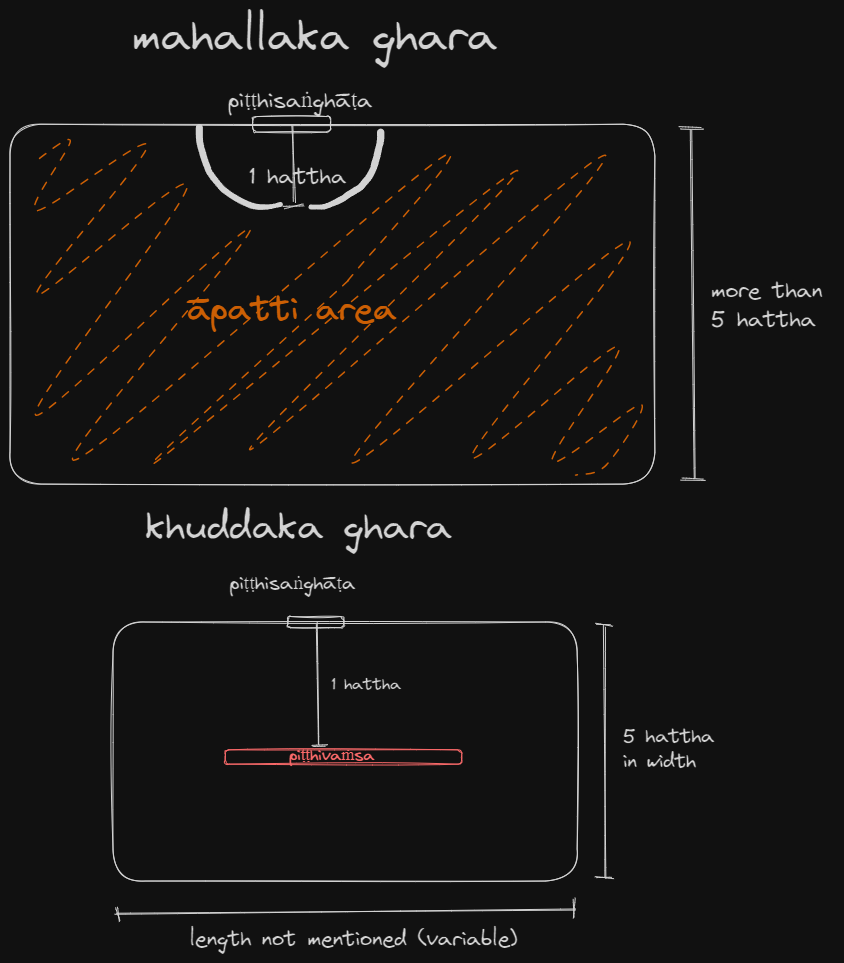
- piṭṭhisaṅghāṭa [piṭṭhi + saṅghāṭa]↔masc. door post; top of the door frame; lit. connection of the lintel #[[pāḷi vocab (3rd year)]]
- piṭṭhivaṃsa↔the center of the room #[[pāḷi vocab (3rd year)]]
- doing so while sitting in another place other than sayanighara: anāpatti
when the couple is lustful, sitting within the hatthapāsa of the doorframe of the bedroom: anāpatti
sitting outside the hatthapāsa (further into the room): āpatti
hatthapāsa here is: 2 1/2 hattha
#q🙋🏼♂
anāpatti
- mahallake ghare piṭṭhasaṅghāṭassa hatthapāsaṃ avijahitvā nisīdati (in a large room, sitting without going beyond the hatthapāsa from the door)
- khuddake ghare piṭṭhivaṃsaṃ anatikkamitvā nisīdati (sitting without entering the center of a small bedroom)
- bhikkhu dutiyo hoti (if there’s another bhikkhu present)
- ubho nikkhantā honti (if the couple has left)
- ubho vītarāgā (if the couple is without lust)
- nothing is mentioned in cases when only one is
- nasayanighare (if the place used to sit is not a bedroom)
aṅga
- ...sabhojane kule...
- pariyuṭṭhitarāgajāyampatikānaṃ sannihitatā: presence of lustful married couple
- dutiyassa bhikkhuno abhāvo: absence of another bhikkhu
- ...anupakhajja nisajjaṃ kappeyya...
- sayanigharatā: there being a bedroom
- anupakhajja nisīdanaṃ: entering and being seated
- Pāḷi
- Yo pana bhikkhu sabhojane kule anupakhajja nisajjaṃ kappeyya, pācittiyaṃ
- If any bhikkhu, having intruded upon a lustful couple, should take seat, this is a case involving expiation
other elements
- citta and saññā
- sacittaka and saññāvimokkha
- sacittakanti anupavisitvā nisīdanacittena sacittakaṃ (having entered with the intention of sitting)
- āpatti and saññā
- tika-pācittiya and duka-dukkaṭa
- saññā: sayanighara / nasayanighara saññā (perception that one is / is not sitting in a bedroom)
- kusalattika and vedanāttika
- akusala citta (lobhamūla)
- vedanā: sukha or upekkhā
rahopaticchanna- and rahonisajja-sikkhāpadaṃ #edited
background (rahopaṭicchanna)
- The Buddha was residing in the Jetavana monastery situated near the city of Sāvatthi. During this time, Venerable Upananda went to his friend’s house and sat on a concealed seat near his wife. The husband who saw this, started blaming Venerable Upananda. Based on this incident the Tathāgata declared this training rule.
background (rahonissajja)
- The Buddha was residing in the Jetavana monastery situated near the city of Sāvatthi. During this time, Venerable Upananda went to his friend’s house and sat on a non-concealed seat near his wife. The man of the house started blaming Venerable Upananda. Based on this incident, the Tahthagata declared this training rule.
description
- being together with and talking to a woman is a pleasurable activity for a man and is particularly searched for when trying to have sex
- location
- 2 related locations
- cakkhussa raho ṭhāna: aka raho paṭicchanna āsana / ṭhāna or even alaṁkammanīya (under aniyata)
- a private place hidden from view where others cannot see even if they raise their eyebrows or their heads (bhamukaṃ / sīsaṁ ukkhipīyamāne)
- that is covered, such as a room surrounded by walls with closed doors, a place covered with cloth, or an area concealed by trees
- sotassa raho ṭhāna / raho ṭhāna: unconcealed (?) area (even a room with an opened door) in which no man / woman is present within 12 hatthas from the monk (average distance within which a conversation can be heard; savaṇupacāra) #q🙋🏼♂
- note:
- raho paṭicchanna āsana / ṭhāna→a seat / place that is private and covered; hidden from view
- alaṁkammanīya↔ a place suitable for having sex (private and hidden from view)
- raho ṭhāna↔an unconcealed area without the presence of a man / woman within 12 hattha from the monk
- both places (cakkhussa and sotassa raho) are mentioned under both rules, but
rahopaṭicchannasikkhāpada is only related to cakkhussa raho ṭhāna
while rahonissajjasikkhāpada is only related to sotassa raho ṭhāna
careful: in an enclosed area, both rules have to be taken into account; in an unenclosed one, only one rule (check why the factors say it must be a non-enclosed area for nissajjana and why we apply nissajjana to cakkhussaraho place) #q🙋🏼♂
- cakkhussa or sotassa raho? (if no other people around)
a room with the door closed: cakkhussa raho
a room with the door opened: sotassa raho
a car: seems to be cakkhussa raho (tbc)
a room with opened windows: windows were not mentioned, so maybe cakkhussa raho
a park: sotassa raho
a park with dense trees: cakkhussa raho
a large room with closed doors with another person only beyond 12 hattha: sotassa raho
the same large room but with a blind person beyond 12 hattha: cakkhussa and sotassa raho
a small room with closed doors with another person within 12 hattha: cakkhussa raho (depends on the person)
the same room with no other person: cakkhussa and sotassa raho
a room with closed doors but glass walls (such as a phone booth / elevator): cakkhussa raho (does not make sense; discuss)
#q🙋🏼♂
- discuss the glass walls case: glass does not function as covering; should not count as such; it can be sound proof, so it should limit the savaṇupacāra but not dassana [special modern case])
- which postures are included in these two rules?
- both the monk and the lady must be either seated (nisajjana) or lying down (sayana) for the offense to occur
- if both seated: āpatti
if both lying down: āpatti
if one is seated and one is lying down: āpatti
if one is standing: anāpatti
- desire
- what is the desire related to both rules?
- the monk must have raho nisajjassāda / rahassāda / nisajjassāda: the desire to sit with a woman alone (not necessarily sexual)
- note:
- the mental state of the woman is not considered here
- aka methunadhammasannissitakilesa since such desire is connected to sexual desire (tappaṭibaddhattā) though there are no sexual feelings necessarily connected with it #q🙋🏼♂
- paṭibaddha [pati + √bandh + ta]↔pp. (+loc) connected (to); bound (to); tied up (with) 2 pp. (+loc) enamoured (with); attracted (to); fixated (by); enslaved (by); lit. bound 3 pp. (+loc) supported (by); dependent (on); lit. bound
- when must the desire be present for the offenses to occur?
- when approaching the place; if it arises after having sat, anāpatti
- the females involved in each of the 2 rules and which are pc / dkṭ vatthu
- rahopaṭicchanna rule:
- mātugāma: any human female ‒ even a newborn infant girl: pc vatthu
paṇḍakas and non-human females in human form (amanussas and tiracchānas): dkṭ vatthu
- rahonisajja rule:
- viññūmātugāma: any human female capable of distinguishing between lewd and non-lewd speech: pc vatthu
aviññūmātugāmas, paṇḍakas and non-human females in human form (amanussas and tiracchānas): dkṭ vatthu
- the third party in each rule
- rahopaṭicchanna rule:
- "anandha" viññū purisa: a man who is not blind and understand what is lewd or not
- rahonisajja rule:
- "anandha abadhira" viññū manussa (purisa / mātugāma): man / woman who is not blind, not deaf, and understands what is lewd or not
- note:
- savaṇupacāra→12 hattha
- dassanupacāra→long distance (depends on whether there is a covering)
- where, in which posture, state of mind should the third party be in each rule?
- where
- rahopaṭicchanna: any distance (within the dassanupacāra, which is a long distance unless there are coverings)
- rahonissajja: within 12 hattha of the monk
- posture:
- walking, standing, or sitting: in any mental state, even asleep
- lying down: not asleep
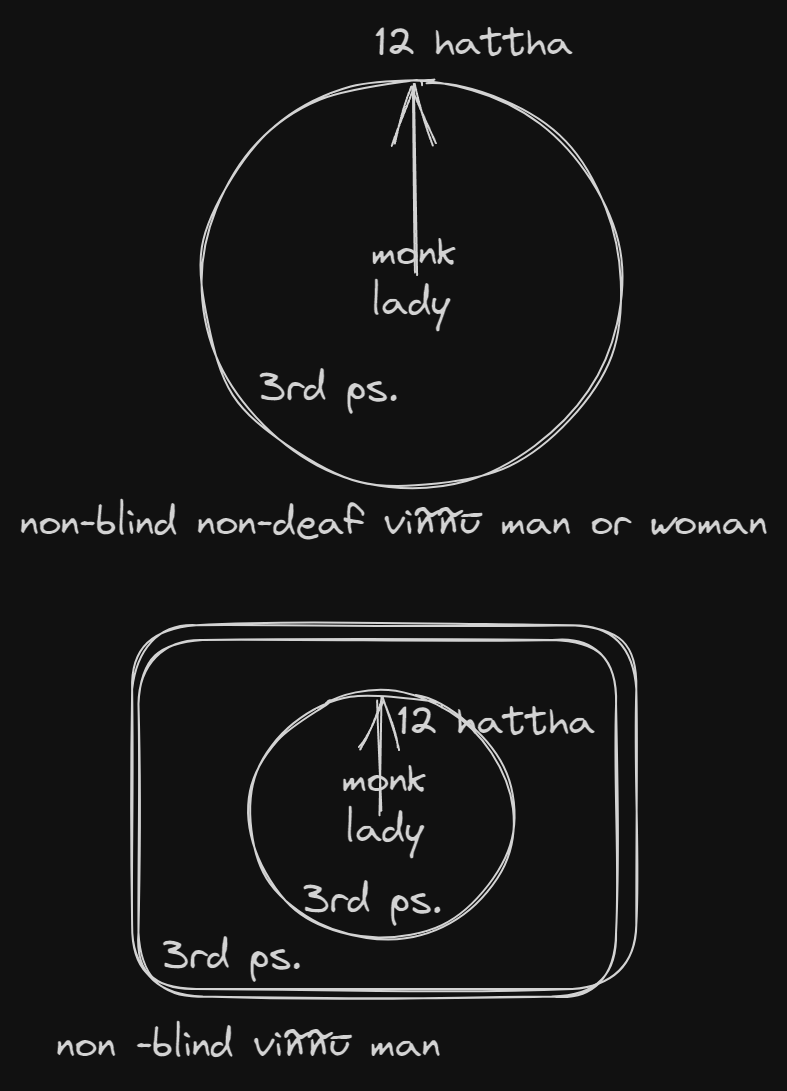
- a cakkhussa raho place with a viññū purisa within 12 hattha: anāpatti
if the purisa is beyond 12 hattha: anāpatti
if another woman is present: āpatti
āpattivāra
- applicable to both rules
- a desirous monk applies medicine to his eyes, wears the antarāvāsaka, ties the belt, and wears the uttarāsaṅga: dkṭ each
he goes to the intended place: dkṭ each step
he sits: dkṭ
the expected woman sits / lies down: pc
she sits / lies down multiple times: multiple pc
another unexpected woman sits / lies down and the monk has desire: pc
if the monk has no desire: anāpatti
if he desires any woman and any woman sits / lies down: āpatti
if he goes without desire and a woman sits / lies down: anāpatti
if after she sits / lies down, the monk has desire: anāpatti
- is the offense with an unexpected woman only comitted with the mind?
- mahāpaccariya-a: no, it occurs as she sits since he came there with asuddha citta—with the desire to be with a woman
- applicable to rahopaṭicchanna rule
- a desirous monk sits with a lady in an enclosed place
‒with a anandha viññū purisa beyond 12 hattha (consider both rules): anāpatti under rahopaṭicchanna, but āpatti under rahonissajja (discuss why factors say unenclosed)
‒with a anandha viññū purisa within 12 hattha: anāpatti
‒with a anandha viññū purisa beyond 12 hattha and an abadhira viññū mātugāma within 12 hattha: anāpatti
if multiple ladies sit / lie down: multiple pc #q🙋🏼♂
- why the distinction between mātugāma and purisa as the 3rd party under rahopaṭicchanna?
- comm: ladies tend to conceal other's sexual activities, but not lewd speech
anāpatti for both rules
- yo koci viññū puriso dutiyo hoti:
- rahopaṭicchanna: anandha viññū purisa (a non-blind man who knows what is / is not lewd speech) within the dassanupacāra and who is not lying down asleep
- rahonissajjana: anandha abadhira viññū manussa (purisa / mātugāma) within the savaṇupacāra who is not lying down asleep
- tiṭṭhati na nisīdati: if any of them stands
- arahopekkho: monk has no desire to be alone with a lady
- aññavihito nisīdati: if the monk is sitting thinking something else
- aññavihita↔adj. being occupied with something else, distracted
aṅga (not given actually)
- rahopaṭicchanna
- yo pana bhikkhu mātugāmena saddhiṃ...: only the bhikkhu and woman being present
- ...raho...: absence of a anandha viññū purisa within the enclosed area
- ...paṭicchanne āsane...: being a concealed seat
- desire to be secretive
- ...nisajjaṃ kappeyya...: (both) being seated / lying down
- rahonisajjana
- ...bhikkhu mātugāmena saddhiṃ eko ekāya...:
- only the bhikkhu and woman being present
- absence of a anandha abadhira viññū manussa (purisa / mātugāma) within 12 hattha
- ...raho...:
- being an unconcealed seat (why do we apply the rule in concealed seats?) #q🙋🏼♂
- desire to be secretive
- ...nisajjaṃ kappeyya...: being seated / lying down
- Pāḷi of both rules
- yo pana bhikkhu mātugāmena saddhiṃ raho paṭicchanne āsane nisajjaṃ kappeyya, pācittiyaṃ.
- yo pana bhikkhu mātugāmena saddhiṃ eko ekāya raho nisajjaṃ kappeyya, pācittiyaṃ.
other elements (both rules)
- citta and saññā
- sacittaka and saññāvimokkha
- āpatti and saññā
- tika-pācittiya and duka-dukkaṭa offence
- saññā: mātugāma / amātugāma saññā (perception that he is sitting with a lady / non-lady)
- kusalattika and vedanāttika
- akusalacitta (lobhamūḷa) with nisajjassāda
- vedanā: sukha / upekkhā
footnotes
- alaṃkammaniyeti kammakkhamaṃ kammayogganti....sakkā hoti paṭisevitunti vuttaṃ hoti. (Pj-a. II. 214.).
- Apihitakavāṭassāti iminā appaṭicchannabhāvaṃ dasseti. Appaṭicchanne ca dutiyasikkhāpade āgatanayena sotassa rahavasenapi paricchedo veditabboti āha "antodvādasahatthepi okāse"ti. "antodvādasahatthe"ti hi idaṃ sotassa rahābhāvaṃ sandhāya vuttaṃ. (Srd-ṭ. II. 379.).
- Ettha ca kiñcāpi pāḷiyaṃ "sotassa raho"ti āgataṃ...Itthīnaṃ pana satampi anāpattiṃ na karotiyeva. (Pj-a. II. 215.).
- Taṃ kammanti taṃ methunādiajjhācārakammaṃ...Paricchedoti rahonisajjāpattiyā vavatthānaṃ. (Vmv-ṭ. I. 305.).
- Pāḷiyaṃ "sotassa raho"ti idaṃ atthuddhāravasena vuttaṃ...tato dūratare nisinnepi cakkhussa rahāsambhavato. (Srd-ṭ. II. 379-80.).
- this idea becomes clear with the following explanation in Vimativinodanī.
- Idāni cakkhuraheneva āpattiṃ paricchinditvā dassento...Yadi hi cakkhusseva rahabhāvaṃ sandhāya vadeyya, "antodvādasahatthe"ti na vadeyya appaṭicchanne tato dūre nisinnepi cakkhussa rahāsambhavato.
- Dvepi apacchā apurimaṃ nisinnā...nipajjitvā niddāyanto na karoti. Itthīnaṃ pana satampi anāpattiṃ na karotiyeva. (Pj-a. II. 215.).
- Kevalañhi idha itthīpi purisopi yo koci viññū anandho abadhiro antodvādasahatthe okāse ṭhito vā nisinno vā vikkhittopi niddāyantopi anāpattiṃ karoti. Badhiro pana cakkhumāpi andho vā abadhiropi na karoti. (Pj-a. II. 217.).
- Raho nisajjassādoti methunadhammasannissitakileso vuccati...Gantvā nisīdati, dukkaṭameva. Mātugāme āgantvā nisinnamatte pācittiyaṃ.
- Sace sā itthī kenaci karaṇīyena uṭṭhāyuṭṭhāya...santikaṃ āgantvā nisinnāya itthiyā rahassādo uppajjati anāpatti. (Pj-a. II. 216-7.).
cārittasikkhāpadaṃ #edited
background
- part 1
- Buddha: Veḷuvana Monastery, Rājagaha
- V. Upananda’s caretaker invited monks for rice meal with akappiya nimantana
- V. Upananda visited other households before the meal, delaying monks and donors
- Buddah banned pre-meal visits (purebhatta)
- part 2
- Upananda’s caregiving household sent khādanīya to the monastery for the Saṅgha, but V. Upananda delayed return
- Buddha banned post-meal visits (pacchābhatta) except to inviting house
- part 3
- monks hesitated to visit during cīvaradānasamaya, reducing robes
- Buddha allowed exceptions
- part 4
- while making robes (cīvarakārasamaya), monks needed tools but hesitated
- Buddha allowed visits
- part 5
- sick monks needed medicine but hesitated
- Buddha allowed permitted visits after informing a monk (santa bhikkhu)
Pāḷi rule
- Yo pana bhikkhu nimantito sabhatto samāno santaṃ bhikkhuṃ anāpucchā purebhattaṃ vā pacchābhattaṃ vā kulesu cārittaṃ āpajjeyya aññatra samayā, pācittiyaṃ. Tatthāyaṃ samayo: cīvaradānasamayo, cīvarakārasamayo ‒ ayaṃ tattha samayo
If any bhikkhu who has been invited for a meal, not having informed a bhikkhu who is present (in the monastery), should go visiting families before the meal or after the meal, except at the right occasions, this is a case involving expiation. Here the occasions are these: the occasion of a giving of robes and the occasion of a making of robes; these are the right occasions here
- samāno: being, having, existing
description
- can a monk, having been invited with an akappiya nimantana, go to another household before mid-day?
- he must inform another upa in the monastery
- majjhaṇha: midday
- applicable time period
- purebhatta: after dawn till the first swallow of the meal
- pacchābhatta: after the first swallow of the meal till the end of the noon
- how to inform
- ahaṃ itthannāmassa gharaṃ gacchāmi
- cārittam apajjāmi
- or such kind of speech
- it should be said with pakati vacana
- pakati vacana↔speech audible within savaṇupacāra (12 hattha)
- what is a santa bhikkhu?
- any upa within the monastery and seen within the savaṇupacāra (12 hattha)
- what if there is no santa bhikkhu?
- no need to search for one
- asanta bhikkhu→not seen within the savaṇupacāra #q🙋🏼♂
- asantaṃ bhikkhuṃ anāpucchā paviṭṭho nāma↔entering (the village) without having informed an asanta bhikkhu (anāpatti)
- 2 samaya
- cīvaradāna samaya
- if no kathinatthāra: during the Kattika month
- with kathinatthara: Kattika + hemanta season (kaṭhinānisaṁsa)
- note: only applicable to monks who observed the purimikā vassa and done the pavāraṇā on the Assayuja full moon day
- cīvarakāra samaya: when a new robe is being prepared (not an old one)
āpattivāra
- without informing one enters the gharūpacāra (vicinity of the house): dkṭ
his first foot passes the entrance (ummāra): dkṭ
his second foot passes: pc
- leaving after midday: anāpatti
visiting another household before the invited meal: pc
visiting after the meal but before midday: pc
- if one intends to inform one monk but informs another and then leaves: anāpatti
leaving without informing when there is no monk within the savaṇupacāra: anāpatti
anāpatti
- samaye
- santaṃ bhikkhuṃ āpucchā pavisati
- asantaṃ bhikkhuṃ anāpucchā pavisati: if no monk is seen within the savanūpacāra from the time the desire to visit the house arises until the moment of leaving the monastery
- aññassa gharena maggo hoti: when the road leads through another's house
(aññassa) gharūpacārena maggo hoti: when the road leads through another's house's vicinity
- kappiyabhūmi
- antarārāmaṃ gacchati: going to a vihāra located in the village
- bhikkhunupassayaṃ gacchati: going to a monastery of bhikkhunīs or a place where bhikkhunīs live
- titthiyaseyyaṃ gacchati: going to a monastery of mendicants of other religions
- paṭikkamanaṃ gacchati: going to a dining hall (āsana sālā)
- bhattiyagharaṃ gacchati: going to the house of a devotee who made the invitation or to a house of a devotee who make frequent meal offerings such as salāka bhatta and so on
- āpadāsu: when in danger
aṅga
- ... nimantito sabhatto samāno...
- pañcannaṃ bhojanānaṃ aññatarena nimantanasādiyanaṃ: having accepted an invitation for one of the five bhojanas
- ... santaṃ bhikkhuṃ anāpucchā ...
- santaṃ bhikkhuṃ anāpucchanā: not informing a bhikkhu in the monastery who is within an area of 12 hattha
- ... purebhattaṃ vā pacchābhattaṃ vā ...
- majjhaṇhikānatikkamo: not having passed the noon (ṭhita majjhaṇha)
- ... kulesu cārittaṃ āpajjeyya...
- bhattiyagharato aññagharappavesanaṃ: entering another household other than the one the invitation was received from
- ... aññatra samayā, pācittiyaṃ.
- samayassa vā āpadānaṃ vā abhāvo: absence of a samaya or disaster
other elements
- citta and saññā
- acittaka and nosaññāvimokkha
- āpatti and saññā
- tika-pācittiya and duka-dukkaṭa
- nimantita / animantita saññā (the perception that he has / has not been invited with an akappiya nimantana)
- kusalattika and vedanāttika
- kusala, akusala or abyākata citta
- vedanā: sukha, dukkha or upekkhā
mahānāmasikkhāpada #edited
background
- Buddha: Nigrodha monastery, Kapilavatthu
- Sakyan King Mahānāma offered medicine to Saṅgha for four months
- Buddha accepted
- monks hesitated, so He declared -- *anujānami, bhikkhave, cātumāsappaccaya pavāranam sādiyitum*
- monks took little medicine
- mahānāma re-offered, but monks hesitated again
- Buddha declared -- *anujānami, bhikkhave, puna pavāranampi sādiyitum*
- monks still took little
- mahānāma offered for life
- Buddha approved, but monks doubted
- Buddha declared -- *anujānami, bhikkhave, niccapavāranampi sādiyitum*
- chabbaggiyas misbehaved
- mahānāma criticized them
- they grudged him and later demanded ghee (doṇa amount) to insult him
- mahānāma asked for a day to fetch it
- chabbaggiyas insulted him for delay
- Buddha set rule
- Kolyan clan / family tree
- Sakyan clan / family tree
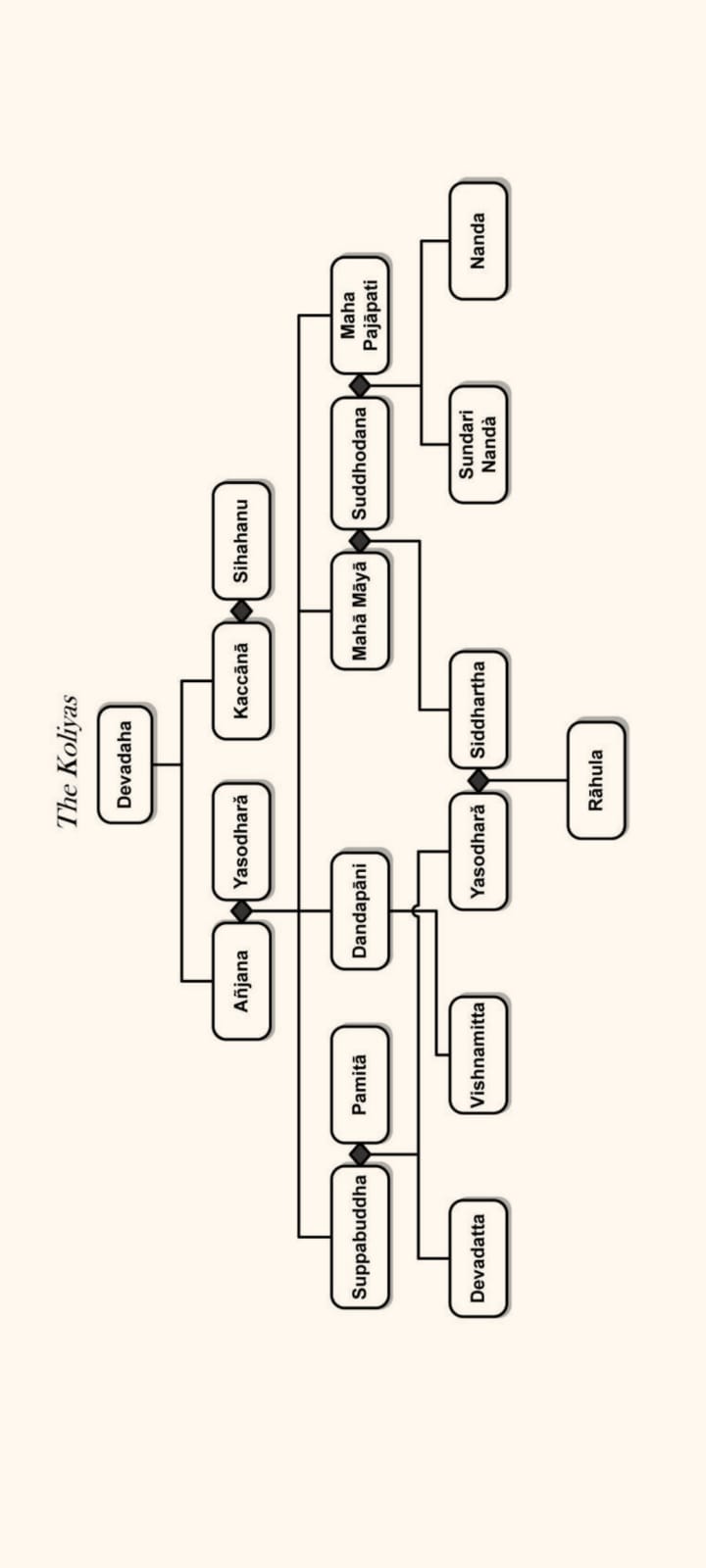
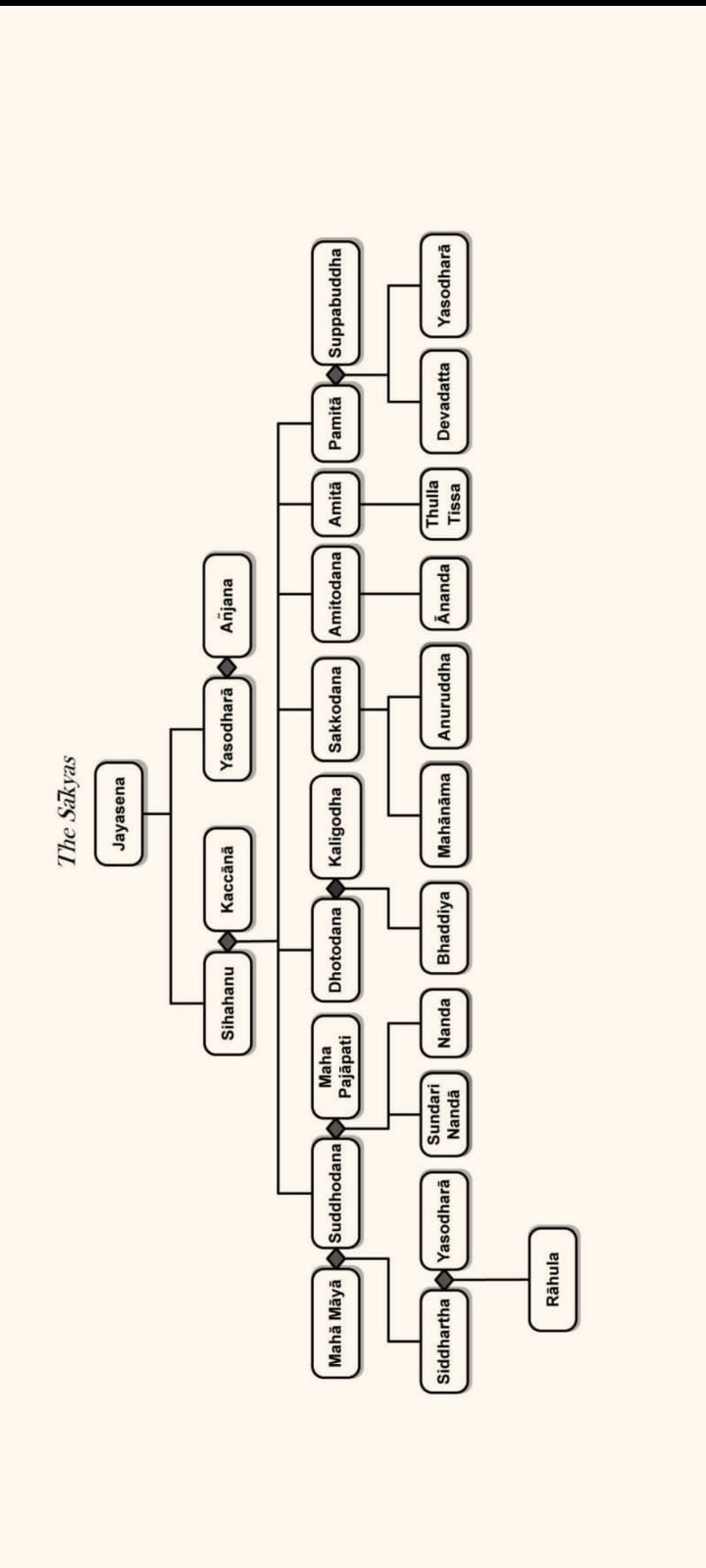
description
- Mahānāma: cousin of the Buddha, son of Sukkodana, elder to the Bodhisatta; his yonger brother was V. Anuruddha; after King Bhaddiya ordained, he became King of the Sakyans
- declared due to the harmful behavior towards Mahānāma by the chabbaggiyas
- difficult to understand according to the wording of the rule
- what should be done when medicine is offered to the saṅgha as catumāsapaccayapavāraṇā / punapavāraṇā / niccapavāraṇā?
- they must be accepted thinking "if I have a sickness, I shall request medicine"
- Catumāsappaccayapavāraṇāti cattāro māse gilānappaccayapavāraṇā, sabbañcetaṃ vatthuvasena vuttaṃ. Ayaṃ panettha attho – catumāsapavāraṇā vā hotu, punapavāraṇā vā, niccapavāraṇā vā, sabbāpi sāditabbā, "idāni mama rogo natthī"ti na paṭikkhipitabbā, "roge pana sati viññāpessāmī"ti adhivāsetabbāti.24
- requesting medicine beyond the saṅghika invitation's limits: pc
- 4 saṅgha pavāraṇā (invitation)
- bhesajja-pariyantā pavāraṇā: invitation for a specific type / quantity / value (in any combinations) of medicine‒I invite the Saṅgha with amalaka...with ten pots of medicine...with medicine worth $100...
- ratti-pariyantā pavāraṇā: invitation for a specific time period‒I invite the Saṅgha for the next four months with medicine
- bhesajja-pariyantā ca ratti-pariyantā ca pavāraṇā: invitation with both specifications‒I invite the Saṅgha with ten pots of ghee for the next four months
- neva bhesajja-pariyantā na ratti-pariyantā pavāraṇā: invitation without specifying both‒I invite the Saṅgha with medicine
- other elements related to the offence
- citta and saññā
- acittaka and nosaññāvimokkha
- āpatti and saññā
- tika-pācittiya and duka-dukkaṭa
- tatuttari / natatuttari saññā
- kusalattika and vedanāttika
- how long does an invitation last if the time period is not specified?
- it is considered a nicca pavāraṇa, but some teachers take it as 4 months
- aññassatthāya chart (asking for another, for the sake of another)
- asking for yourself
your devotees / relatives: yes
other bhukkhus' devotees, relatives: no
others: no, but if sick, yes
asking for another bhikkhu
your devotees / relatives: yes
that bhukkhu's devotees, relatives: yes
others: no (why not? if someone is like, in a coma, can't we ask for his sake?)
āpattivāra
- bhesajjapariyante
asking for a different type of medicine: pc
asking more than the specified quantity: pc
rattipariyante
asking for medicine having exceeded that time period: pc
bhesajjapariyante ca rattipariyante ca
asking for a different type of medicine or exceeding the quantity and exceeding the duration: pc
neva bhesajja-pariyantā na ratti-pariyantā pavāraṇā
asking for any type of medicine in any amount at any day: anāpatti
requesting for medicine while not requiring that particular medicine: pc
when sick, asking for another medicine other than the one one needs: pc
when sick, asking for the medicine one needs from anyone: anāpatti
anāpatti
- yehi bhesajjehi pavārito hoti tāni bhesajjāni viññāpeti: requesting for the medicine with which the Saṅgha has been invited
- yāsu rattīsu pavārito hoti tāsu rattīsu viññāpeti: requesting during the duration mentioned in the invitation
- “Imehi tayā bhesajjehi pavāritāmha, amhākañca iminā ca iminā ca bhesajjena attho"ti ācikkhitvā viññāpeti: saying to the donor “You have invited us with such and such medicine, but we are in need of this and that type of medicine"
- "yāsu tayā rattīsu pavāritāmha tāyo ca rattiyo vītivattā amhākañca bhesajjena attho"ti ācikkhitvā viññāpeti: if the monk says to the devotee “You have invited us with medicine for this duration and that duration has elapsed. But now we are in need of medicine”
- ñātakānaṃ pavāritānaṃ: asking from ñataka pavārita donor (inviter here not included)
- careful: here, the inviter is not a pavārita devotee
- aññassatthāya: requesting from his own ñātaka and pavārita devotees to offer to another monk; the ñātaka and pavārita devotees of another monk to offer medicine to that monk
- aññassatthāya chart (asking for another, for the sake of another)
- asking for yourself
your devotees / relatives: yes
other bhukkhu's devotees, relatives: no
others: no, but if sick, yes
asking for another bhikkhu
your devotees / relatives: yes
that bhukkhu's devotees, relatives: yes
others: no
- attano dhanena: requesting for medicine using his allowable requisites such as robes, bowl and money kept with a lay devotee for the monk’s use
aṅga
- agilānena bhikkhunā...(agilānatā): not being ill
- asking beyond the invitation when sick: āpatti
- when sick, one can ask for medicine, but not based on that particular invitation
- only applies to: na bhesajjena karaṇīyena bhesajjaṃ viññāpeti, āpatti pācittiyassa
- (/:q: clarify/)
- ...cātumāsapaccayapavāraṇā sāditabbā...(pavāraṇatā): an invitation to the saṅgha
- (/:q: what if it's not for the saṅgha?/)
- ...tato ce uttari sādiyeyya...
- bhesajjaviññatti: requesting the inviter for medicine
- pariyantātikkamo: requesting beyond the specifications mentioned in the invitation
- pāḷi
- Agilānena bhikkhunā catumāsappaccayā pavāraṇā sāditabbā aññatra punapavāraṇāya, aññatra niccapavāraṇāya, tato ce uttari sādiyeyya, pācittiyaṃ.
By a bhikkhu who is not ill a four-month invitation for requisites can be accepted; except with a repeated invitation, except with a permanent invitation; if he should accept more than that, [this is a case] involving expiation
extra notes:
- some theras have medicines in order to maintain health
uyyuttasenāsikkhāpadaṃ #edited
background
- B in jetavana; king pasenadī kosala left with army; chabbaggiyas went to see them. king asked why; monks said to see him. king questioned their intent, suggesting they see tathāgata. soldiers criticized buddha’s followers. tathāgata set uyyutta senā rule, banning monks from seeing armies heading to battle. later, a soldier, a bhikkhu’s uncle, fell ill, sent for his nephew monk to visit. buddha added sub-rule allowing visits to army for valid reasons.
description
- reason: war is not suitable; enjoying things connected to it is also not suitable
- senā→a single troop or an army of troops (hatthi / assa / ratha / patti senā)
- 4 types of troops (senā)
- hatthi senā (troop of elephants): 1 elephant with 12 men (4 on the animal's back; 2 protecting each leg)
- assa senā (troop of horses): 1 horse with 3 men (1 on the horse; 2 protecting its legs)
- ratha senā (troop of chariots): 1 chariot with 4 men (1 on the chariot; 1 is a fighter (yodha) and 2 protect the pin of the wheel-axle)
- patti senā (troop of soldiers): 4 men carrying bows and arrows
- caturaṅganī senā
- a fourfold army: a collection of all the 4 troops
- uyyutta senā
- niviṭṭhā senā↔ (deployed, settled-down troops): troops that have left the village for battle and are camping
- payātā senā↔ (deployed troops) troops that were deployed for battle
- vocab:
- uyyutta [ud + √yuj + ta] adj. (of an army) deployed; on active duty; on the march; (comm) camped or on the march; lit. departed; 2 pp. energetic, parading #[[pāḷi vocab (3rd year)]]
- payāta [pa + √yā + ta] pp. set out; gone forward; advanced; 2 adj. (of an army) deployed; on the march; lit. gone forward #[[pāḷi vocab (3rd year)]]
- anuyyuttā senā
- troops when in other business other than war such as escorting the king to visit a park, etc
āpattivāra
- leaving intending to see an uyyutta senā: dkṭ every step
looking at it: pc
leaving the dassanūpacāra due to some obstruction and going to another place to see it again: pc again
visiting and seeing a non-caturaṅgaṇī senā (incomplete army): dkṭ
seeing a complete anuyyutta senā: anāpatti
- Īdisaṃ senaṃ dassanāya gacchato pade pade dukkaṭaṃ. Dassanūpacāraṃ vijahitvāti kenaci antaritā vā ninnaṃ oruḷhā vā na dissati, idha ṭhatvā na sakkā daṭṭhunti aññaṃ ṭhānaṃ gantvā passato payoge payoge pācittiyanti attho. (V-a. III. 125.).
- non-caturaṅgaṇī senā: less than a complete army
anāpattivāra
- ārāme ṭhito passati: if it comes to the sight of a monk in the monastery (ārāma)
- ārāme ṭhatvā attano ṭhitokāsaṃ āgataṃ…passato… anāpatti. (Kaṅkhā. 236.).
- bhikkhussa ṭhitokāsaṃ vā nisinnokāsaṃ vā nipannokāsaṃ vā āgacchati: if it comes to where the monk is either standing, sitting or lying down
- paṭipathaṃ gacchanto passati: if meeting it on the way (books says in the village)
- tathārūpappaccayā: if there is a suitable reason (to visit the sick, etc)
- āpadāsu: when in danger (jīvitantarāya / brahmacariyantarāya): going to the army that has set out for battle thinking “I shall be free from danger having gone there”
aṅga
- ...uyyuttaṃ senaṃ...(uyyuttasenā): for the full offense it must be caturaṅganīsenā
- ...dassanāya gaccheyya...(dassanatthāya gamanaṃ)
- anuññātokāsato aññatra dassanaṃ: watching from an unapproved place
- anuññā↔fem. sanction, permission #[[pāḷi vocab (3rd year)]]
- anuññāta [anu + √ñā + ta]↔pp. allowed; permitted #[[pāḷi vocab (3rd year)]]
- ...aññatra tathārūpapaccayā...(tathārūpapaccayassa āpadāya vā abhāvo): lack of a suitable reason or dangers
- Pāḷi
- Yo pana bhikkhu uyyuttaṃ senaṃ dassanāya gaccheyya, aññatra tathārūpapaccayā, pācittiyaṃ.
If any bhikkhu should go to visit an army in action; except with an appropriate reason, [this is a case] involving expiation.
other elements
- citta and saññā
- sacittaka and saññāvimokkha
- āpatti and saññā
- tika-pācittiya and duka-dukkaṭa
- uyyutta / anuyutta saññā (perception that the army seen has / has not left for battle)
- kusalattika and vedanāttika
- akusala citta
- sukha, dukkha or upekkhā
senāvāsasikkhāpadaṃ #edited
background
- The Buddha was residing in the Jetavana monastery near the city of Sāvatthi. During this time the Chabbaggiya bhikkhus had visited the army troops for a certain reason and stayed with them for more than three nights. The people belonging to the army criticized the monks, inquiring how they could be staying with the troops. Based on this incident, the Tathāgata declared the senāvāsa training rule prohibiting monks from staying with the troops for a longer time
āpattivāra
- spending 3 consecutive nights (dawns) with the senā and the 4th sunset happens: pc
spending 2 consecutive nights with the senā, leaving before the 3rd dawn, and returning after it: anāpatti (it must be consecutive nights)
spending 3 dawns and then leaving before sunset: anāpatti
if its caturaṅganī senā: ?
if its a non-caturaṅganī senā: ? #q🙋🏼♂
- when does the offense happen?
- at sunset of the 4th consecutive day
- 1st night | 2nd night | 3rd night | 4th night (āpatti at sunset)
- is there an offense if the sunset occurs and one is not lying down?
- yes, the offense occurs regardless of the posture ‒ even in mid-air with abhiññā
- “Atthaṅgate sūriye senāya vasatīti tiṭṭhatu vā nisīdatu vā sayatu vā sacepi ākāse iddhiyā kañci iriyāpathaṃ kappeti, pācittiyameva”.
anāpattivāra
- dvetisso rattiyo vasati: spending 2 / 3 nights
- ūnakadvetisso rattiyo vasati: spending less than 2 / 3 nights
- dve rattiyo vasitvā tatiyāya rattiyā purāruṇā nikkhamitvā puna vasati: if one spends 2 nights, leaves before the 3rd dawn, spends the dawn away, returns and again stays there
- 1st night | 2nd night | (leaves early) 3rd night | (returns) 1st night...
- gilāno vasati: if one falls sick while with the troops
- gilānassa karaṇīyena vasati: if performing duties to the sick (another sick monk)
- senā vā paṭisenāya ruddhā hoti: if the army is blocked by enemies
- kenaci palibuddho hoti: if someone prevents one's departure
- āpadāsu: when in danger (jīvitantarāya / brahmacariyantarāya) thinking “I shall be free from danger while being here”
aṅga
- ...Tato ce uttariṃ vaseyya...
- tirattātikkamo: exceeding the third night
- senāya sūriyassa atthaṅgamo: setting of the sun on the fourth day while still in the troops’ presence (why this discrepancy between dawn and sunset and how we count?) #q🙋🏼♂
- gilānatādīnaṃ abhāvo: lack of reasons such as being ill and so on
- Pāḷi
- Siyā ca tassa bhikkhuno kocideva paccayo senaṃ gamanāya, dirattatirattaṃ tena bhikkhunā senāya vasitabbaṃ. Tato ce uttariṃ vaseyya, pācittiyaṃ.
And if there might be any reason for that bhikkhu to go to the army, two or three nights can be stayed with the army by that bhikkhu; if he should stay more than that, [this is a case] involving expiation.
other elements
- citta and saññā
- acittaka and nosaññāvimokkha
- āpatti and saññā
- tika-pācittiya and duka-dukkaṭa
- atireka / ūnaka saññā (perception that the night is exceeding / not the limit)
- kusalattika and vedanāttika
uyyodhikasikkhāpadaṃ #edited
background
- Buddha in Jetavana; chabbaggiyas went to visit the 4 places while residing with the army; one was shot and was wounded; the troops criticized them
description
- 4 places that should not be visited while staying with troops
- uyyodhika↔battlefield #[[pāḷi vocab (3rd year)]]
- balagga↔where troops are counted #[[pāḷi vocab (3rd year)]]
- senābyuha↔place where troops are organized #[[pāḷi vocab (3rd year)]]
- Senāya viyūhanti "ito hatthī hontu, ito assā hontu, ito rathā hontu, ito pattī hontū"ti senāya ṭhapanaṃ, rāsiṃ katvā ṭhapananti attho. Tenāha "senāsannivesassetaṃ nāma"nti. (Kaṅkhā abh-ṭ. 401.).
- anīka↔organized squadrons #[[pāḷi vocab (3rd year)]]
- anīkadassana↔the act of seeing the squadron
- 4 types of anīka
- hatthānīka: at least 3 hatthi senā
- assānīka: at least 3 assa senā
- rathānīka: at least 3 ratha senā
- pattānīka: at least 3 patti senā
- Tayo hatthī pacchimaṃ hatthānīkanti yo pubbe vutto dvādasapuriso hatthīti tena hatthinā tayo hatthī. Sesesupi eseva nayo. (V-a. III. 126.).
āpattivāra (not given actually)
- every step while going to see any of the 4 places: dkṭ
looking at them: pc
leaving the dassanūpacāra and again returning to see: pc every time
anāpatti
- ārāme ṭhito passati
- bhikkhussa ṭhitokāsaṃ vā nisinnokāsaṃ vā nipannokāsaṃ vā āgantvā sampahāro (battle) dissati:
- sampahāra [saṃ + pa + √har + *a]↔masc. fighting; clash; battle; lit. strike together #[[pāḷi vocab (3rd year)]]
- paṭipathaṃ gacchanto passati
- sati karaṇīye gantvā passati
- allowed reasons are not given; they may be taken from the previous rule; sikkhapada does not say aññatra tathārūpapaccayā, but this anāpatti factors shows the allowance
- āpadāsu: jīvitantarāya or brahmacariyantarāya thinking “I shall be free from danger having gone there”
aṅga
- ...uyyodhikaṃ vā balaggaṃ vā senābyūhaṃ vā anīkadassanaṃ vā gaccheyya...(uyyodhikādidassanatthāya gamanaṃ): going to see one of them
- anuññātokāsato aññatra dassanaṃ: looking from a location that is not allowed
- tathārūpapaccayassa āpadāya vā abhāvo: lack of an allowed reason
- Pāḷi
- Dirattatirattañce bhikkhu senāya vasamāno uyyodhikaṃ vā balaggaṃ vā senābyūhaṃ vā anīkadassanaṃ vā gaccheyya, pācittiyaṃ.
If a bhikkhu staying two nights or three nights with an army should go to a battle field, or a review, or a massing of the army, or an inspection of units, [this is a case] involving expiation.
other elements
- citta and saññā
- sacittaka and saññāvimokkha
- āpatti and saññā
- tika-pācittiya and duka-dukkaṭa
- sañña is not given
- kusalattika and vedanāttika
- akusala citta
- sukha, dukkha or upekkhā
extra notes
upacāra
- gharupacāra
bounded: the entire area is the upacāra
unbounded: a broomthrow by a lady
gāma / vihāra upacāra
bounded: the boundary marks the upacāra
unbounded: 1 leddupāta (a stone's throw by a strong man)‒but 2 are used because of doubt
- note: gāma and gāmupacāra are the same in the end
- leḍḍupāta [leḍḍu + pāta]↔masc. stone’s throw; lit. stone’s fall #[[pāḷi vocab (3rd year)]]
3 rules related to nimantana
- gaṇabhojana, paramparabhojana, and cārittasikkhāpada